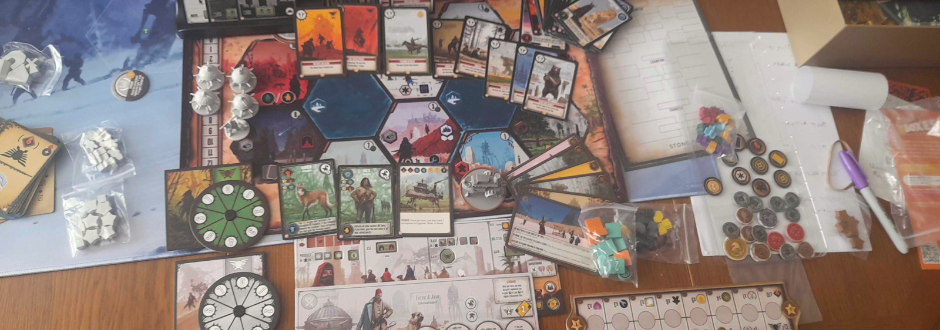
A Game I Had Been Chasing
Inis and I have a complicated history.
Not because I had played it before and bounced off it. Quite the opposite. I had been trying to play the bloody thing for years.
Blood Rage by Eric M. Lang was one of the first big-name hobby board games I fell in love with, and somewhere along the way YouTube decided that meant I also needed to hear about Inis. Again. And again. And again. Both games came out around the same period, both put colourful plastic clans onto a map, both revolve heavily around card drafting, and comparisons between them were pretty much inevitable.
The frustrating bit was that almost everything I watched had lovely things to say about Inis, while actually finding a copy was another matter entirely. So it sat on that increasingly dangerous mental list of games I absolutely had to try someday.
Someday finally arrived with the Third Edition.
Matagot's new edition arrived around the game's tenth anniversary, with a visual refresh, updated components and rules presentation, while leaving Christian Martinez's underlying design intact. It is still a 2-4 player game built around drafting, hand management, territorial presence and a wonderfully strange form of political warfare.
And before we even get to any of that, I love this box.
The particular shade of green works beautifully, especially with the little hits of gold foil across the artwork. It looks like something old and mythological without resorting to the usual muddy browns fantasy games sometimes drown themselves in.
After waiting this long, I really hoped I would like the game inside it.
Luckily, Inis did not make me wait several years just to disappoint me.
My first game was with a close friend and two of her friends, giving us a four-player table with wildly different levels of board gaming experience. I have played more games than is probably healthy. My friend has played plenty but had never played a card-drafting game. One of the others had some hobby gaming experience. The fourth had only ever played Monopoly and its relatives.
The one thing everyone had in common was an interest in mythology and learning about different cultures.
I actually knew this because, being entirely normal about organising a game night, I had sent everyone questionnaires beforehand.
Greek, Egyptian and Norse mythology are fairly easy to encounter where I live, whether through Percy Jackson, Marvel, Madeline Miller or a dozen other bits of popular culture. Irish Celtic mythology is a different story. Balor, the Morrígan, Tír na nÓg and the Dagda were new territory for most of the table.
That made Inis immediately interesting before even a single card was played.
So there I was, sitting directly under an AC blasting cold air into my face, trying to maintain both body temperature and credibility while teaching three people a game I had never played before.
I had studied that rulebook like there was an exam at the end of it.
About thirty minutes, every granular detail, several edge cases and a regrettable number of bad jokes later, we were ready.
Four Cards and an Island
The funny thing about Inis is that once the explanation is over, the actual game is almost suspiciously simple.
The island begins with a number of territory tiles equal to the number of players. The Brenn chooses the Capital, turn order is established, and everyone takes turns placing clans until each player has two on the map. At four players, the Action deck contains only 17 cards. One is secretly removed each round and the remaining 16 are dealt out, four to each player, before the draft begins.
That tiny deck is the beating heart of Inis.
The rules themselves make this explicit: almost everything you actually do in the game comes from playing cards. Want more clans? You need the right card. Want to move? Card. Build a Sanctuary? Card. Explore and bolt another gorgeous chunk of Ireland onto the map? Card. Start trouble with your neighbour? There is, naturally, a card for that too.
Most of those cards revolve around a handful of easily understood verbs: recruit, move, build and clash.
By our third round, even the newer players were recognising cards by their artwork and remembering what had already gone around the table. The game gives everyone a tiny shared vocabulary and then checks how cleverly you can speak it.
The drafting itself has one excellent twist.
Unlike something like Blood Rage, the card you initially pick is not permanently yours. Every time another packet reaches you, you combine it with what you previously kept and decide again which cards to hold and which to pass. That means a plan you formed thirty seconds ago can be abandoned when something better appears. You are repeatedly reassessing what cards you need based on what everyone else has shown you.
And, crucially, you are also drafting information.
There are only 17 Action cards. You know one is missing. You know what you have seen. Eventually, you know what you passed to the person currently smiling far too innocently across the table.
Some may see this familiarity as a weakness, arguing that repeatedly seeing the same 17 cards drains some surprise from the draft. I land almost entirely on the opposite side. For me, that predictability is where the strategy starts getting interesting. The deck slowly stops being a pile of possibilities and becomes something you can actually read.
Then there is passing.
On your turn you may play a card, take a Pretender token if you qualify for one, or simply pass. But passing does not remove you from the round. If somebody plays afterwards and the turn eventually comes back to you, you can jump straight back in. The round only ends when everyone passes consecutively.
That sounds like nothing.
It absolutely isn't.
Sometimes the strongest card in your hand is the one you don't play because you want someone else to commit first.
A Crown You Don't Win by Conquest
This is also where Inis begins separating itself from the dudes-on-a-map games it superficially resembles.
You are not trying to wipe everyone else from the board.
In fact, indiscriminate murder can actively make one of your victory conditions harder.
There are three ways to establish your claim to the High Kingship. You can be present in six or more territories. You can be present across territories containing at least six Sanctuaries. Or you can become chieftain of territories that collectively contain at least six opposing clans. Deed tokens can also act as a wild helping you progress towards any of these conditions.
That third condition is especially clever.
You are not rewarded for removing six enemy figures, but for being chieftain over them.
Your opponents are, quite literally, part of the evidence that you deserve to rule.
That one rule does an enormous amount of work. Suddenly coexistence matters. Presence matters. Being the largest clan in a territory may matter more than making yourself the only clan there.
Combat reflects that same philosophy.
When a clash begins, Citadels can shelter clans from what follows. Exposed players then take turns making manoeuvres. An attack does not automatically kill somebody. The attacked player chooses whether to remove a clan or discard an Action card from their hand. And before each manoeuvre, the players involved can simply agree that they have made their point and end the clash.
Throwing away one of your four Action cards can be every bit as painful as losing a clan because those cards are your future turns. A fight can therefore be about territory, but it can just as easily be about stripping someone of the ability to execute whatever horrible plan you know they drafted earlier.
And peace is always sitting there on the table.
“I'm only passing through.”
“I don't care about this territory.”
“Hit her instead. She's the one about to win.”
Maybe those statements are even true.
This is where Inis becomes far more political than its fairly clean rules suggest. The most interesting conflicts are often extensions of diplomacy, temporary alliances and the shared problem of deciding how much effort everyone is willing to spend stopping somebody else.
Inis also makes you publicly announce that you might be about to win.
Once you satisfy at least one victory condition, you can spend your turn taking a Pretender token. You then have to survive until the next Assembly, when only players holding Pretender tokens are checked. If multiple Pretenders remain, whoever fulfils the greatest number of victory conditions wins, with the Brenn potentially breaking a tie.
There is no sneaking across a victory-point threshold while everyone looks elsewhere.
The Real Battlefield Is the Table
Our first game took around two and a half hours, considerably longer than the roughly 60-90 minutes generally listed for the Third Edition. But that was four people learning the game together, including two people with fairly little experience in this kind of design, so I would not use our first session as a stopwatch for future plays.
What surprised me was how little the difference in gaming experience ultimately mattered.
Our final round reached the point where all four of us had managed to claim Pretender tokens.
Everyone was in contention.
And the eventual winner?
The person with the least board gaming experience.
She qualified for two victory conditions and took the High Kingship while the supposedly more experienced people around the table failed to stop her.
I love that. The fact that the complexity does not come primarily from remembering 47 interconnected subsystems. Once you know what the cards do, the rules fade backwards and the players come forwards.
I consider Inis a fantastic step deeper into the hobby for someone who is curious and willing to pay attention. The rules are unusually straightforward for the amount of agency the game eventually gives you, and the Third Edition rulebook must absolutely be praised for its clarity.
The strategic ceiling is much higher than the rules overhead suggests.
There is also a potential downside hiding inside that sentence.
Inis is incredibly interactive. In the “everybody at this table has noticed what you are doing and would now like you to stop” sense.
The Pretender system naturally produces dogpiles. An obvious leader may spend an entire round being dismantled. A player who cannot win may still have enormous influence over which contender survives. I can see why some praise the political drama and others call out kingmaking or repetitive late-game cycles where the table keeps dragging the next would-be winner back down. I personally don't think that is an accidental flaw hiding in Inis, it is part of what the game is. Your group simply needs to enjoy that kind of thing.
If somebody gets genuinely annoyed when three players notice that they are winning and collectively decide to ruin their afternoon, Inis is going to test that friendship.
Personally?
That sounds like a good evening to me.
Myth, Art and a Very Limp Spear
Then there is the artwork.
Good lord.
The oversized cards were already one of Inis' defining features, and the Third Edition gives the game a refreshed visual presentation while retaining that extraordinary mythological identity. The current edition has 17 Action cards, 16 territory-linked Advantage cards and 30 Epic Tale cards, alongside 16 enormous modular territory tiles.
This might now be my favourite artwork in any board game I own.
Sorry, The Old King's Crown. You had a good run.
It is not just that the individual pieces are pretty. Inis looks unlike almost anything else on the table. The colours are bold. The people are stylised. The landscapes have this strange, dreamlike quality to them. The giant irregular territory tiles lock together into an island that looks less like a military map and more like somebody slowly assembling an illustrated storybook.
And the Epic Tale cards are something else.
These are the game's less predictable cards, acquired through particular effects and kept between rounds until used. They evoke characters and episodes from Irish Celtic legend, and the rulebook actually takes the time to explain the stories behind them: Diarmuid and Gráinne, Balor's Eye, the Battle of Moytura, Cú Chulainn, the Dagda's harp and cauldron, the Morrígan, the Stone of Fal, the Children of Dana and plenty more.
I adore this stuff.
A game does not need to educate me to justify its theme, but there is something special about finishing a session knowing just enough about a character or myth to want to go read more afterwards.
It also helps the Epic Tales feel genuinely epic. The Action deck becomes increasingly knowable as everybody learns the game. The red cards remain those little pockets of mythological mystery somebody may have been quietly sitting on for three rounds.
That unpredictability will not please everyone. A some of the Epic Tales too situational to provide the dramatic combat twists it wanted.
For me, they hit a nice balance. I don't want the entire game to become unknowable card chaos, but I also don't want every confrontation to be solved like a spreadsheet.
The physical production is a more mixed story.
The tiles are lovely. The cards are enormous and clear. The new green box is probably my favourite Inis cover so far. The cardboard insert inside mine, though, is considerably less regal.
Mine was already damaged in a couple of places when I opened the box, and cards have an annoying habit of slipping underneath one of the dividers. I will probably end up 3D printing an insert.
The clan figures are also merely fine. A lot of my spear-wielding clans appear to have suffered a devastating pre-game military defeat against gravity.
Limp spear syndrome.
And, amusingly, this apparently isn't just my Third Edition copy. Old reviews of the original game back in 2016 specifically complained about bent plastic, including limp spears and leaning figures. A decade later, the clans are apparently still struggling with the same medical condition.
I'll probably 3D print replacements for those eventually as well.
None of this ruins the production. Far from it. Once the island is spread across the table and those cards start moving around, Inis is gorgeous.
I just wish the bits tasked with storing and populating that beautiful island felt quite as good as the art itself.
The Third Edition also has a practical future-facing reason to exist. It refreshed the visual
presentation and rulebook, and Matagot's retail Nemed expansion is designed around this edition. Nemed adds modular sacred sites, dedicated Sanctuaries and additional territories and Epic Tales, which sounds exactly like the sort of thing I want after spending more time with the base game.
I haven't played it, so that is where my commentary on Nemed ends.
But I am very interested.
Who Inis Is Actually For
Ten years after the original release, I understand why people would not shut up about this game.
Inis is simple in an increasingly rare way.
It gives you a small set of cards, three visible ways to win, a handful of clans and an island that grows as you explore it. Then it lets the players create most of the complexity themselves.
Your first few rounds are about learning what the cards do.
Then you start remembering what everyone else drafted.
Then you realise passing is an action.
Then you realise a clash can be won without killing anyone.
Then you realise the player happily allowing three of your clans to survive in their territory may not be showing mercy at all. They may need you alive because those clans are helping fulfil their Leadership condition.
That is Inis.
It is also why the perennial comparison with Blood Rage only takes you so far. Both are colourful, interactive games with drafting and plastic warriors on a map, but Blood Rage revels in spectacular battles, card combinations and increasingly powerful strategies across its three Ages. Inis is leaner, stranger and more political. Its little Action deck remains constant. What changes is what everyone at the table knows about it.
I would recommend it to players who enjoy direct interaction, tactical card play and games where reading the table matters just as much as reading your own hand.
I would especially recommend it to people who like the idea of an area-control game where war is only one tool among several, and often not the best one.
I would be more cautious with groups that dislike kingmaking, pile-ons or having their plans directly disrupted. Inis does not put a polite little multiplayer-solitaire wall around your strategy. Your opponents are part of the puzzle, and sometimes the correct move for all three of them is to make your life miserable.
For curious newer players, I think it can work brilliantly with the right teacher. My own table proved that. I would not throw it at somebody simply because they enjoyed Ticket to Ride once, but for a newer player who is interested in the theme and wants to see what deeper hobby games can do, Inis is a fantastic door to open.
Our least experienced player walked through that door and promptly took the throne from all of us.
Final Verdict
I spent years wanting to play Inis, which is always slightly dangerous. Board games have an annoying habit of becoming flawless when you cannot actually get hold of them. You watch reviews, read discussions, hear people praise the design, and eventually you are just waiting to see whether a cardboard box can survive the myth you built around it.
Inis did. It is elegant without being bloodless, simple without being shallow, and interactive in the best way possible. The Third Edition doesn’t reinvent Christian Martinez’s design so much as remind you why it mattered in the first place. Ten years on, Inis still feels sharp, mystical, and utterly deserving of its reputation.
OVERALL
Artwork: 5/5
Complexity: 3/5
Replayability: 4/5
Component Quality: 3/5
Player Interaction: 5/5
Things you might like:
- Some of the best artwork I have seen in a board game
- Simple rules with serious strategic depth beneath them
- A tiny Action card deck that becomes more interesting the more you understand it
- Three excellent victory conditions that reward presence, leadership, and sacred sites rather than simple conquest
- Brilliantly tense Pretender system where the table gets one last chance to stop a would-be High King
- Negotiated conflict that makes battles feel political rather than purely destructive
- Epic Tale cards that bring in Celtic myth to life
- A fantastic step deeper into the hobby for curious newer players with the right teacher
Things you might not like:
- The open victory system can create dogpiles or kingmaking moments
- Very interactive, so players who dislike having their plans disrupted may bounce off it
- The insert can feel a bit flimsy, with cards slipping under the dividers
- Some of the spear-holding clan figures tend to be a bit bent.
Overall Score: 95/100