




Introduction
I was on holiday in Wales last year and we went white water rafting. It was great fun, but it was quite a short stretch of river and so we were transported by minibus back to the start twice over. Just before landing the raft each time, we went over a weir and had some action photos taken.
In the game of Boonlake, you have a boat that goes down river and over a weir four times, triggering a scoring round. That’s a little like having action photos taken? OK, I’m probably stretching the analogy too much here. There are weirs in Boonlake, but it’s not really about white water. Boonlake is an action selection game, and the boat movement is the timer for the game, which ends after the fourth (interim) scoring round.
Introduction
I was on holiday in Wales last year and we went white water rafting. It was great fun, but it was quite a short stretch of river and so we were transported by minibus back to the start twice over. Just before landing the raft each time, we went over a weir and had some action photos taken.
In the game of Boonlake, you have a boat that goes down river and over a weir four times, triggering a scoring round. That’s a little like having action photos taken? OK, I’m probably stretching the analogy too much here. There are weirs in Boonlake, but it’s not really about white water. Boonlake is an action selection game, and the boat movement is the timer for the game, which ends after the fourth (interim) scoring round.

You only return to the start of the river once in Boonlake and there are three weirs, one of which you will go over twice. The river forks just after this weir and the first time you take the left fork (in the sense in which the boat is travelling) and the second time you proceed down the right fork.
Gameplay
Each player has a player board with pieces that can be placed on the main game board to improve income and scoring for the next and subsequent weirs. These pieces are ten inhabitants, six houses, four settlements, and five cattle. Inhabitants are cowboys sleeping under the stars, who then upgrade to houses, which may be subsequently upgraded to settlements. There are hex spaces on the main board, which can be explored – take a tile from the face-down stack and place it adjacent to a tile already on the board. Once explored, the tile can be developed by sending an inhabitant to the tile. One point that is important to note is that you have a number of inhabitants on the corner of your player board – this is called your ranch – and the rest apart from two, are in your supply, off your player board. The inhabitants in your ranch are available to you, to be used for actions. Inhabitants in your supply must be recruited first before they can be used. I said “apart from two” – there are two inhabitants on your board in recessed spaces and these are tier bonuses, only unlocked when you clear all the other spaces in that row.

There are two other areas on your player board. In the top left are your canoes and this is how you generate resources, which are used to pay for cards. Canoes can move to the right, downstream, at no cost, but moving any distance to the left costs two coins. There are four spaces, each of which can accommodate one or both of your canoes. The resources are wood, loam, stone, and iron and they are generated by the position of the canoes on your turn, but they are never stored, so there are no wood counters etc. Two canoes in the wood space will generate two wood and similarly for the other resources. Above each resource is a production site and you start the game with your choice of one of the four possible production markers on its +1 side. There are opportunities to add more and upgrade existing to +2 during the game. The production sites give a permanent +1/+2 of their particular resource. On the right-hand side of your player board are your levers which act as once-per-weir anytime actions. These levers reset at each interim scoring, and you score extra for any you didn’t use. You build the levers through the progress / modernize action and use one at any time by moving its tile down within the recess.
You start the game with a hand of six cards. Cards have a cost in resources, which may be a combination of coins, wood/loam/stone/iron, and vases. Coins and vases are returned to the supply when spent, while wood/loam/stone/iron just needs your canoes to be in the correct positions to generate these resources – but remember that these are never retained or accumulated and there are no tokens to represent wood etc. So, I like to think of these as virtual resources, where you just need to demonstrate you have access to sufficient quantities of them. There is an extra complication with the cards in that they belong to one of three suits – day, sunset, night – and this is indicated in the top left corner. Some actions only allow you to play a card of a particular suit. Once the card is played, it will have an effect that is either:
a. immediate such as gaining coins or taking inhabitants from supply to your ranch, or
b. ongoing such as a discount on costs or additional coins, cards or vases when triggered or
c. end-of-game scoring modifiers such as extra victory points per house removed from your player board

In addition to this, cards may have a victory point value at the bottom right. This is scored at the end of the game. The cards function in a similar way to cards in Terraforming Mars and the deck is pretty huge too – 165 cards in total. Cards are also a resource and there are many opportunities to discard cards for coins.
The main board is divided into four regions – Unknown, Boonlake, Southern, and New Hope. One of the actions is to trigger a regional scoring and income and some other effects are keyed to a particular region(s).
The core of the game is the action selection board. A set of seven action tiles are shuffled and placed on the board. Each turn, the active player selects one tile and does the action(s) on it, then there are following actions done by every player (and in one case excluding the active player) and finally the active player moves their ship according to the row that the action tile was in. Higher up the board gives more ship moves, lower down give fewer with the bottom two positions requiring extra payment of victory points.

Each place on the river has a bonus for ending the turn with your ship on it. At the end of all this, the tile is put at the bottom of the action board, and everything is shuffled up to close the gap.
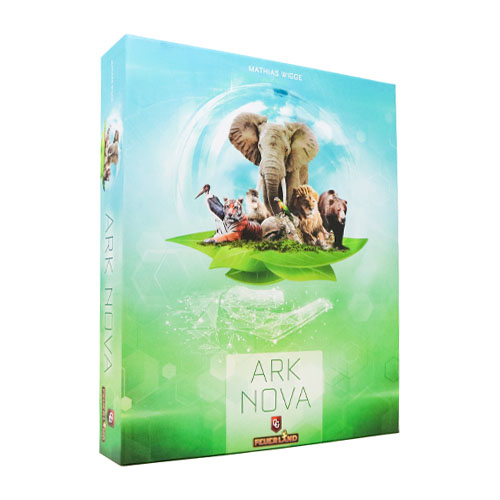
This method of action selection is very similar to Ark Nova, but here the tiles are communal, and one person’s turn affects everyone else’s.
The available actions are:
· Explore – put a building tile on the board and take the reward it covers up
· Develop – put an inhabitant on an available space on a building tile, paying the cost and taking the reward if applicable
· Upgrade – turn an inhabitant into a house or a house into a settlement
· Cattle breeding – put a new cattle pasture (hex tile) on the board and then place a cattle piece from your player board
· Score a region – gain the reward, move the region marker to cover it, and then gain coins for presence in the other three regions
· Hire – a combination of gain a new inhabitant from the supply and exploring once
· Progress – add a lever tile to your player board, paying the cost
· Build – play a card of any kind (all the other actions usually allow playing a card but only of one kind)
On the left-hand side of the main board there are two income tracks, one for coins and one for cards. This income is paid out at interim scoring. There are also victory points available for getting high on these tracks.
Along the bottom of the main board are four scoring tiles which are chosen at the beginning of the game. Each player is dealt two and choses one, then if there are fewer than four players the empty slots are filled with a random tile. At each interim scoring players will need to put one of their scoring markers in the space corresponding to their player colour on one of the tiles. This means that each player scores each tile once over the course of the game. The one-point marker is for the first interim scoring, the two point for the second and so on. The twist here is that if the player does not meet the scoring condition in the form of a threshold value, then the score is negative. The scoring tile that a player chose at the beginning counts double for this scoring.

The upper half of each scoring tile is a special project that can be completed instead of playing a card from hand. It is effectively a special card that belongs to all three suits for the purposes of all effect that are keyed to the suit or type.
Artwork
Good thematic artwork on the cards, the boards, the box, and the rulebook – all consistent with the theme of ranchers in the Old West. The pieces are basic coloured wooden meeples and so forth. I think this is a 3/5 for artwork.
Likes and dislikes
I really like the project cards, the free-action levers and the scoring mechanisms. I also love the idea of virtual resources. I like the gameplay with the system of main action plus minor following actions for everyone – something we see in games like Earth – and the action-selection-rotation system, which is similar to Ark Nova.
If I have a dislike, it’s the learning curve for the dictionary of iconography. Once you get it straight in your head, it’s all pretty logical, but there are a lot of symbols to become familiar with, and it makes teaching it for the first time harder than might be expected. Also, a minor quibble is the dual-layered player boards need sticking together with the supplied sticky tabs. Sky Team does this too and I’m always a little worried that I’ll mess it up!
Complexity
As I’ve already said, this is an action selection game and once you learn the iconography it’s pretty straightforward. There are some tough decisions to make, such as which scoring tile to score at each interim point. It’s not the crunchiest of games, though, and there shouldn’t be any analysis paralysis. I’ll give it a 3/5 for complexity.
Replayability
A deck of 165 cards, 42 building tiles, and 16 scoring tiles provide many possible combinations and a lot of replayability. Every game will be different. I’ll say 5/5 for replayability.
Player interaction
The central mechanism of the game is the action selection tiles and because they are communal, these ensure a lot of player interaction. Hex tile placement on the main board is also competed over. This makes for a 5/5 for player interaction.
Component quality
Components are cardboard tiles and tokens and coloured wooden pieces. The coins are cardboard too. The player boards are dual layered, which is nice. Nothing wrong with the component quality, but in a world of “blingflation”, I would only give it a 3/5.
Conclusion
This is a fun game that was very popular when it first appeared a few years ago, but it isn’t talked about much at the moment. It had been a while since I had played it, so I dug it out recently and gave it a spin. It is still as good as I remembered. This is a 75% from me for the overall score.
This game has elements that are reminiscent of other games – the action selection rotation from Ark Nova, the large deck of project cards from Terraforming Mars, Ark Nova (again), or Earth, the scoring tiles which are rather like the milestones and achievements in Terraforming Mars. The hex tile placement is also used in many games. If you like any of these or similar games, you should definitely investigate Boonlake.