How does a developer follow up one of the greatest board game releases of the last five years without simply treading water? This was the task Scorpion Masque had on their hands with their 2025 release Tag Team, following on from one of my favourite games of all time Sky Team. Unlike in Sky Team however, this time you’re not plucky pilots working together to land a plane, but legends and heroes battling against one another for epic victory over your opponent. Clearly inspired by arcade fighting games of old like Tekken and Street Fighter, Tag Team brings those 1v1 fighters to the tabletop as you pair up two combatants to go head to head in an auto battler, in combination with one of my favourite game mechanics deck building for a truly epic clash of heroic proportions. After the success of Sky Team, and other fantastic games from Scorpion Masque like Decrypto and Turing Machine, Tag Team was one of the releases this year I was most hyped about, and couldn’t wait to get into battle. But was this auto battler an automatic victory, or did it simply crash and burn on its way to the ring?
Tag Me In
Tag Team is a very straightforward battle, with the first steps simply being drafting two characters from the 12 different unique fighters that come in the box.
How does a developer follow up one of the greatest board game releases of the last five years without simply treading water? This was the task Scorpion Masque had on their hands with their 2025 release Tag Team, following on from one of my favourite games of all time Sky Team. Unlike in Sky Team however, this time you’re not plucky pilots working together to land a plane, but legends and heroes battling against one another for epic victory over your opponent. Clearly inspired by arcade fighting games of old like Tekken and Street Fighter, Tag Team brings those 1v1 fighters to the tabletop as you pair up two combatants to go head to head in an auto battler, in combination with one of my favourite game mechanics deck building for a truly epic clash of heroic proportions. After the success of Sky Team, and other fantastic games from Scorpion Masque like Decrypto and Turing Machine, Tag Team was one of the releases this year I was most hyped about, and couldn’t wait to get into battle. But was this auto battler an automatic victory, or did it simply crash and burn on its way to the ring?
Tag Me In
Tag Team is a very straightforward battle, with the first steps simply being drafting two characters from the 12 different unique fighters that come in the box.
Once you have done this, you take the starter cards from both characters, mash together and shuffle their decks, and finally choose the order of the two starter cards you want to play first. Be careful though, as your first decision in the game happens immediately, which card starts, as you can never again change the order of these cards.
Your opponent does the same, and you both reveal your cards at the same time one after the another, trying to do damage or block the opposing fighter. Once a round is done and all cards revealed, you get to add in one further card from the deck you previously shuffled, strategically adding it into your deck where it can cause the biggest problem for your opponent.
Rounds continue like this where you build up your deck, trying to remember as well the order of your opponents cards, and finally hoping to knock out one of the fighters on your opponent’s team first to win the game.
The cards can do attacks, blocks, and special actions associated with the particular hero in question, with all the characters in the game playing differently, varying in complexity and tactics. Games are quick, over in 10-15 minutes just like an arcade fighting game, and you can then just go again with the same fighters or try a new combo of combatants.
And ultimately my immediate impression of the game was, Scorpion Masque, you have smashed it again. As I think Tag Team is a winner in every sense of the word.
A Perfect Combo
I have now done many games of Tag Team and tried out every single character in the box, and thus far its only improved my experience of the game.
As stated before all of the 12 characters are properly distinctive. The fact that rather than a 1v1 fight you get to do 2 vs 2 and combine two different characters, allows for every match to feel different. Combinations emerge that are incredible when they come off, and the battles even if only 5 or 10 minutes long become epic clashes of play styles and powers.
There is so much replayability in a relatively small box, and you will want to just keep having one more fight every time you get it to the table. It generates that feeling of putting one more pound coin into the arcade machine for another go so well, that it goes against my usual preference of preferring bigger, more prolonged strategic battles from my board games.
Over time you genuinely get better at the game as well. As you grow more accustomed and familiar with how each fighter plays, you will soon understand their strengths and weaknesses, how they complement other characters, how they can counter your opponents. You will learn where to place your cards in the deck to create an auto fighting death machine, you will figure out how to best balance the need for defence as well as attack, and how to get the most out of your characters special abilities.
In my first game as Bodvar and Wong Fei-Hung I only really choose cards to get Bodvar to turn into his bear form as quickly as possible, which left him defenceless and Wong Fei-Hung useless. Instead I should have shown patience, let Wong keep Bodvar alive with his power manipulation and healing while Bodvar slowly rages and builds himself to his stronger form.
The Golem works perfectly as a tank shield with an aggressive attacker like Mordred, The Wild Bunch can be played so that they become almost immortal when paired with the right characters, there is just so much to it and you might think of combinations that haven’t even crossed my mind about how to play two fighters together.
The battles are very short and sweet but within them is so much tactical play that every match feels properly special, with Tag Team in this humble board game bloggers opinion being the ultimate replayable game. In itself it’s a perfect combination of games like Unmatched and Smash Up, with a little bit of Colt Express programming in there, but I think it improves on other games of its ilk for its ability to hook you in to repeat plays again and again until you feel like you’ve mastered every characters quirk.
Judge a Game by its Box
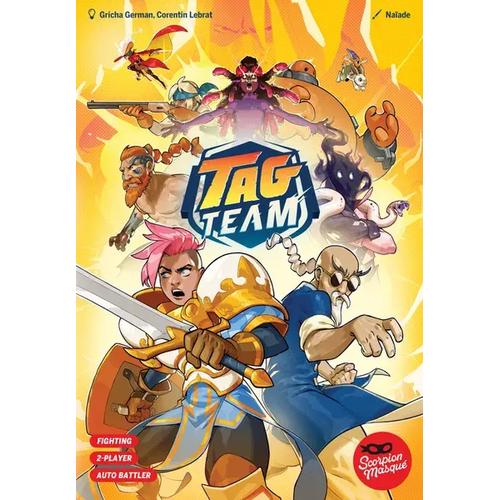
In all my reviews I will usually have a section dedicated to artwork, and its because I feel it is so important for a board game to bring their theme to life to draw people in to play it and to make your game feel unique. Tag Team excels at this. They say don’t judge a book by its cover but the box Tag Team comes in simply cannot be passed without wanting to have a little look inside. The beautifully shiny colours of yellow, red and blue pops out, with the different fighters taking centre stage with a grand design on the front cover.
And in a game where its USP is making every fighter feel different, the art for each character helps to achieve this before you’ve even played a game. In particular I love the character models for Shango, Mephisto and Maman Brijit, but each character has a different style and look that will appeal to you. Like any good arcade fighting game, you will soon have a favourite, a main, that you will want to perfect, and often it’s the style of the art and the design that will first draw you in to a character, before you get into any of the nitty gritty tactics and combos of how they play. Tag Team is a beautiful game, with a box that I know I could always get someone interested to play with me, before revealing the incredible gameplay that can be found within.
Final Thoughts
Tag Team managed to scratch an itch in my board game collection that I didn’t even know was there, and have truly loved my time with it. Even writing about it here makes me want to get a game of it going as soon as possible!
I would say its potentially not for everyone, the battles are really short and can end very abruptly. If you’re playing against an experienced player you might find you get beaten very quickly and this might feel a little unfair, and some of the characters do feel a lot weaker than others, at least until you’ve got your head around how some of them play. (Bodvar why is your health so bloody low!).
It rewards repeat plays but this might be a detriment to someone who doesn’t want to have to keep playing something in order to better understand it and get the most out of the game. The rulebook as well, while I appreciate its attempt to keep it fairly light and breezy, does have some notable gaps so occasional stops in play to rule check on the internet can be frustrating, especially for a newer game where something might not have been covered online yet.
As such while I might think it’s the ultimate replayable game, others might find that after two quick defeats they want to move onto something larger in scale, whether that’s something like Unmatched which generally plays for a bit longer and feels more balanced no matter people’s skill level, or Kelp which is a fantastic asymmetric two player game of a shark chasing down an octopus, which does an amazing job of within one board game having two characters play totally differently, while creating a fair matchup that you can enjoy the push/pull of over its roughly one hour game time. Or perhaps you just prefer two player co-ops like Sky Team which has you working together rather than trying to destroy one another. For me though I have loved every play of Tag Team, whether I have been victorious or ceremoniously battered within 5 minutes. I think it’s a game ripe for expansions, which would add even greater variety if you did feel that after repeated plays you had seen what each character can do, and I will certainly be keeping my eye on Zatu for any news on an expansion!
You’re enjoyment and opinion of this game will simply be down to your preference on mechanics and whether you think this game is perfect for repeated plays or over too quickly to enjoy. But if you love a two player head to head game, or a game with lots of different characters and ways to play, or even adore old school arcade fighters, and want to learn how to truly master a board game, then Tag Team is perfect for you. For myself, it might be my favourite game of 2025, and an instant favourite in my ever expanding collection of board games.
About the Author:
Paul Websell is a freelance contributor for Zatu who spends his time either playing board and video games or talking about them. While he’s not on social media, you can view his other blogs right here on Zatu!
Zatu Review Summary
Zatu Score
90%
Rating
Artwork
Complexity
Replayability
Interaction
Component Quality
Read More
Tag Team is a quick, two-player auto battler that plays out in around 10–15 minutes. The rules are easy to pick up, but the real depth comes from the characters themselves. Each fighter has their own abilities, strengths, and weaknesses, meaning the match can feel very different depending on who you bring into the ring.
A lot of the strategy happens before the first card is even played. Picking the right pair of characters (and understanding how they work together) is just as important as what happens during the fight. With twelve characters in the current roster, and more on promises with expansions, there’s plenty of room to experiment with different playstyles and matchups.
Tag Team is a quick, two-player auto battler that plays out in around 10–15 minutes. The rules are easy to pick up, but the real depth comes from the characters themselves. Each fighter has their own abilities, strengths, and weaknesses, meaning the match can feel very different depending on who you bring into the ring.
A lot of the strategy happens before the first card is even played. Picking the right pair of characters (and understanding how they work together) is just as important as what happens during the fight. With twelve characters in the current roster, and more on promises with expansions, there’s plenty of room to experiment with different playstyles and matchups.
Core Concepts
In Tag Team, each player controls two characters who take turns fighting as a team. Over the course of the match, players build a fight deck that drives all actions in combat. Once cards are added to the deck, their order is locked in, so everything resolves in a known sequence.
This fixed order is where most of the decision-making comes from. You’re not just choosing what to add to the deck, but when it will happen. Good play is about timing your attacks, managing your characters’ abilities, and setting things up so your opponent can’t respond in time.
Components Overview
The game keeps components to a minimum. Each character has a card that shows their abilities and health, with additional cards used to build the fight deck during play. A small number of tokens track health and any ongoing effects, keeping the focus on the characters rather than bookkeeping.
Setup
First, players choose the two characters that will make up their Tag Team. There are a few different ways to handle this, depending on how experienced (or competitive) you want the game to be.
Beginner Pick
For your first game, it’s recommended to stick with one of the suggested pairings: Ching-Shih and Joan, or Bodvar and Wong Fei Hung. These teams are straightforward, forgiving, and a good way to learn how the game flows.
Regular Draft
Deal the draft cards evenly between both players. Each player picks one character, then passes their remaining cards to the other player and chooses their second character from that new hand.
Competitive Draft
This works the same way as the Regular Draft, except before passing the remaining cards to the other player, each player secretly discards one card face down. This adds a bit of mind games and denial to the draft.
Just Pick Them
Ignore all of the above and pick whoever you feel like playing. Simple as that.
Once you’ve chosen your characters, set up their player boards. Place each character’s health counter, starting power (shown at the top of the card), and any other character-specific tokens or trackers listed on their board.
Next, take the decks for both of your characters. Remove each character’s starting card (the one with the black border), then shuffle the remaining cards together to form a single draw pile.
Finally, using your starting cards, decide the order they’ll resolve and place them face down in front of you as your fight deck. Cards are always played from the top of this deck, so whatever’s on top will trigger first.
Gameplay
Gameplay in Tag Team is quick and straightforward, alternating between two phases: the Fight Phase and the Build Phase.
During the Fight Phase, both players flip the top card of their fight deck at the same time and resolve its effect. This counts as a turn. The character on the revealed card is your active character for that turn, while your other character acts as their partner. Unless a card says otherwise, all attacks and effects target your opponent’s active character. The strength of an attack is based on the active character’s current power, which builds up over the course of the game and carries over between turns.
Once the turn is resolved, both players flip the next card and repeat the process, stacking cards as they go. The Fight Phase continues until there are no cards left in your fight deck. As the game goes on and decks get bigger, this phase naturally takes longer each round.
After that, you move into the Build Phase. Draw the top three cards from your build deck, choose one to add to your fight deck, and discard the other two to the bottom of the build deck in any order. You can’t reorder your fight deck, so the key decision here is where you slot that new card in, timing is everything.
How the Game Ends
The aim of the game is simple: knock out one of your opponent’s characters. A character is KO’d when their HP is reduced to the KO marker on their health track.
If, at the end of a turn, one of your opponent’s characters has been knocked out, the game immediately ends and you win. If both players score a KO on the same turn, the match ends in a draw.
In the rare case that a player completely runs out of cards in their build deck and can’t draw during the Build Phase, the game also ends in a draw.
Character Overview
The Golem, The Colossal Protector
Tank, protector, and all-around big guy, The Golem is a force you don’t want to mess with. With the highest base HP in the game at 20, he can take some hits and afford to take a few risks.
His signature ability, Protect the Innocent, gives your partner a free shield to block incoming attacks, but it costs The Golem 3 damage. Then there’s Reanimation, which lets the next card you play activate twice. Between these two abilities, it’s tempting to just play him as support, but with three basic attack cards in his deck and solid power generation, The Golem can quickly turn into a heavy hitter. Most of his power comes from losing health, so by soaking damage for his partner with Protection, he’ll build up power fast.
The Golem pairs really well with characters who can heal him, letting him generate even more power safely. Joan and The Fey Folks are great examples, especially since Protection adds an extra safety layer for them. You can also use Protection to help fragile characters like Bödvar survive longer. Other solid pairings include Milady and The Wild Bunch, but honestly, The Golem is flexible enough that he often ends up picked, or banned, in just about every game.
Bödvar, The Berserker
This beastly berserker is the very definition of a glass cannon. Starting with low HP and 3 power, your goal early in the game is simple: survive long enough to build up rage and power, then transform into your bear form and unleash all that stored-up fury. When your rage tracker is full, you instantly gain 3 power, flip your board to the bear side, and set your HP equal to your current power. Most of Bödvar’s cards have two actions, one for human form and one for bear form, with the bear actions dealing some truly devastating hits.
Bödvar’s playstyle is all about timing. You need to stay alive long enough to transform with enough power to really dominate your opponent. That makes him a risky pick, if you can’t block effectively or survive the early turns, he can be tough to use.
To help him thrive, pair Bödvar with characters who can protect or heal him. The Golem and Joan are great options, with Joan also helping build his power faster. Other solid partners include The Wild Bunch and Wong Fei-Hung, who help him generate power quickly while offering a little healing or protection. But when everything comes together and Bödvar transforms into bear form with a good stock of power, there’s nothing more satisfying than stomping your opponent into submission. Joan, The Divine Shield
If you had to sum up Joan in one word, it would be reliable. With plenty of healing, ways to build power for both herself and her partner through her divine voice, a solid handful of blocks, and even some attacking options, Joan is the definition of an all-round support character. She’s probably the single most flexible character in Tag Team, able to slot comfortably into almost any pairing.
Abilities like Divine Vision, which heals both characters, and Sword of St Michael, which heals Joan while she attacks, make her surprisingly hard to take down, all while she’s steadily building power for the whole team. She rarely feels like a weak link, and even when she’s not dealing big damage herself, she’s always doing something useful.
When it comes to pairing Joan with other characters, you really can’t go wrong. She works especially well with heavy hitters like Mordred, The Golem, Bödvar, and Milady, keeping them healthy and powered up while they do the dirty work. She’s also a great safety net for trickier characters like Shango, as her constant healing gives them the time they need to get set up. Realistically, if Joan is on your team, you’re already in a good spot, no matter who you pair her with.
Ching-Shih, The Pirate Queen
As her signature ability suggests, Ching-Shih is very much the terror of the seas. Starting with an attack already on her starting card gives her an immediate edge, letting her apply pressure early while she begins building her fleet. One look at her player board and you’ll notice the large tracker that climbs all the way to 20. Starting at 0 ships, the Pirate Queen slowly builds her armada, with her abilities changing depending on how many ships she has.
This shifting power curve is what makes Ching-Shih tricky to play. Her starting card, Terror of the Seas, loses its attack once she reaches 8 ships, switching focus to healing instead, and then changes again at 16 ships. The real hail-mary comes at 20 ships, when Terror of the Seas sets both opposing characters to 1 HP, usually putting victory firmly within reach. Play her cards right and Ching-Shih is a serious threat; misjudge the timing and she can end up feeling like a sitting duck.
Ideally, Ching-Shih wants a fast game and shouldn’t rely on ever hitting 20 ships. Winning within the first few rounds is often the plan, which makes her a great fit alongside aggressive partners like Mephisto, Maman Brijit, and The Wild Bunch, all of whom want to close the game out quickly. On the flip side, it’s usually best to avoid pairing her into characters like Mordred or Wong Fei-Hung, who thrive in longer games and want time to build power, especially if Wong Fei-Hung manages to remove her starting card with his crippling touch.
Mordred, The Black Knight
Personally, Mordred is one of my favourite characters to play. He’s an absolute tank, starting with 19 base health and packing a kit full of blocks. Mordred wants to slow the game right down while he steadily builds power. His starting card, Dark Power, won’t even attack until he’s reached 8 power, until then, it simply generates 1 power each time it’s played.
Most of Mordred’s damage (and healing) actually comes from blocking. Depending on the card, a successful block will either heal him back up or trigger a heavy retaliatory hit. His Hidden Blade attacks can be tricky to land, as they’re fairly easy to counter, but when timed well they can still swing a fight. There’s also Execution, which instantly KOs any opponent on 4 HP or less. It’s not his main win condition, but it’s always a threat your opponent has to respect.
Mordred really shines when you can pile power onto him, so his best partners are characters who help accelerate that game plan. Wong Fei-Hung, The Wild Bunch, The Fey Folk, and Joan all work well, offering faster power generation alongside their own sustain. That said, Mordred is very self-sufficient and can realistically be paired with just about anyone, he’s happy to sit back, soak hits, and wait for the perfect moment to strike.
The Wild Bunch, The Band of Outlaws
Heavily dependent on perfect timing and playing your cards just right, The Wild Bunch are some of the hardest, but most rewarding, characters to play in Tag Team. At first glance they look incredibly fragile, starting with just 5 HP. However, each space on their health track has a stop, meaning they can never take more than 1 damage in a single turn (or heal more than 1 HP). This makes them deceptively durable if played well.
True to their theme as a band of outlaws, their core mechanic revolves around keeping the Sheriff on their side. Their starting card, Corrupted Lawman, sets the tone: if you control the Sheriff, you attack and then pass the Sheriff to your opponent; if your opponent has it, you both gain 1 power and the Sheriff returns to you. Several of their cards only work if the Sheriff is on your side, while others will actively help your opponent if they control him when the card resolves. This is why timing is absolutely key, knowing when to give up the Sheriff and when to pull him back is what separates good Wild Bunch play from great Wild Bunch play.
With access to some team healing and surprisingly heavy damage, The Wild Bunch can be fairly flexible when everything lines up. They won’t forgive sloppy play, but when you’re in control, they feel fantastic.
Starting with 1 power—and giving their partner 1 starting power as well—The Wild Bunch pair nicely with characters who benefit from early momentum, like Ching-Shih or Maman Brijit. They also work well alongside characters who appreciate extra durability, such as Bödvar and The Golem. The Wild Bunch are incredibly fun once they click, but expect them to take a few games before you really get a feel for how to use the Sheriff to your advantage.
Milady, The Cloak and Dagger
As one of the most setup-reliant characters in the game, Milady can easily catch opponents off guard, often leaving them wondering what just happened. Throughout the match, Milady plants Schemes face down. These come from a stack of 11 tiles unique to her, which you shuffle together at the start of the game. The effects vary wildly, granting power to you and/or your partner, attacking, healing your partner, or, most commonly, Poison.
Poison is where Milady really shines. Instead of normal damage, Poison deals direct damage by halving your opponent’s current health, which, at the right moment, can be absolutely devastating. Milady has several ways to unleash her Schemes. Cards like Checkmate trigger one immediately, while So Predictable unleashes a Scheme if you successfully block an attack. More often than not, though, Schemes are triggered by passing certain checkmarks on her health tracker, meaning taking a hit can suddenly turn into an even bigger blow for your opponent.
Because she needs time to set things up, Milady benefits from partners who can give her a bit of breathing room. The Golem, The Wild Bunch, and The Fey Folk all provide durability or protection that lets her get her plans in motion. That said, I often find myself pairing Milady with just about anyone, she’s more than capable of holding her own once her engine is running.
Milady is a strong pick and a lot of fun to play, but my one gripe with her is how unpredictable her Schemes can feel. When everything lines up, she’s incredible—but sometimes you’re left hoping the right tile flips at the right time. Mephisto, The Agent of Darkness
Mephisto offers some of the most satisfying gameplay in Tag Team, as long as you can get the timing right. Their entire kit revolves around the Serpent token, which has two sides: White Serpent and Black Serpent. During setup, you flip it like a coin and start on whichever side it lands on. Most of Mephisto’s cards have different effects depending on which side is showing, and many will flip the token as part of their resolution.
The White Serpent side focuses on healing and building power, while the Black Serpent is all about dealing damage and ending the game quickly. With only one block card in their deck, Mephisto isn’t built to play defensively. They want to apply pressure early and keep it up, carefully managing the Serpent token to stay on the right side at the right time. One of their standout cards, Drag You to Hell, can instantly win the game if Mephisto would otherwise be KO’d that turn, making for some incredibly tense moments.
Mephisto is one of the most self-sufficient characters in the game and barely interacts with their partner at all. You can pair them with almost anyone, but characters like The Fey Folk or The Wild Bunch are particularly useful for the extra starting power. Just be careful around the midpoint of their health track, where a forced Serpent flip can completely derail your plans if you’re not paying attention.
Wong Fei-Hung, The Old Master
This Kung Fu master channels his chi, manipulating both his own power and his partner’s to strike fast and hit hard. His starting card, The Harder They Fall, places a Concentration token on the opponent. If they already have one, Wong Fei-Hung instead attacks using the opponent’s current power, which can be surprisingly effective when timed well.
A big part of Wong Fei-Hung’s kit revolves around power manipulation. Many of his abilities let him transfer power directly to his partner, allowing them to ramp up very quickly. On top of that, Ging Balance lets him set his power equal to his partner’s after a successful block, keeping him relevant even without many direct attacks of his own. Crippling Touch is his most disruptive tool, a one-time card that removes the card it’s played against from the game entirely, though you need to be careful when using it against The Fey Folk, as it can accidentally make them invincible.
I really like running Wong Fei-Hung alongside heavy hitters like Mordred and Bödvar, where his ability to funnel power into his partner can completely change the pace of the game. He’s a character I initially overlooked, as the Concentration mechanic is easily countered and he lacks consistent attacks, but once I leaned into his power manipulation, he quickly became one of my favourite characters to play and pair with others.
The Fey Folk, The People of the Forest
What’s better than one character? Three. The Fey Folk are easily one of the most unique picks in Tag Team. With three separate health tracks and a Spirit tracker, they might look fragile at first glance, but they’re far tougher than they appear.
At the start of the game, you choose one Fey Folk to activate, moving the health marker to their track and gaining that character’s activation bonus, which is either power for yourself or your partner. When an active Fey Folk is knocked out, you gain one Spirit and activate the next character. The key thing to understand is that The Fey Folk don’t actually lose the game just because all three characters are knocked out. The only way they can be fully KO’d is if their starter card, All Legends Must Pass, is played while all three are already Spirits. Until that happens, you’re still in the game.
Their deck also includes three powerful summon cards. Each one starts inactive and must be successfully blocked with before it flips into its summoned state for the rest of the game. Once active, these summons can heal both characters, build power on both characters, or attack with both characters. On top of that, The Fey Folk have access to attacks and heals that scale with the number of Spirits you have, as well as a very strong card cancel in Entanglement.
The Fey Folk work extremely well as a support pick and can slot into a lot of different pairings. The Golem is a standout partner, creating a duo that’s incredibly hard to kill while steadily ramping up damage. Timing your cancel cards properly can completely shut down your opponent’s plans, so don’t overlook these small but mighty heroes.
Maman Brijit, The Immortal Sorceress
Immortal isn’t used lightly here. The first thing you’ll notice about Maman Brijit’s health tracker is that there are two KO spaces, but below them sits another space entirely. If her health ends on one of the KO spaces, she’s properly knocked out. But if she takes more damage than needed and drops past those spaces, she instead gains 1 power and heals back up to 4 health. Against characters with 6 or more power, this can turn into an endless loop of almost dying, gaining power, and standing straight back up again.
Maman Brijit’s starting card, Chili Pepper Rum, is a basic attack that costs her 1 direct damage, and having early access to an attack is always great for applying pressure. Most of her abilities follow a similar pattern, costing 1 direct damage to herself or her partner in exchange for healing, gaining power, or attacking. Like The Fey Folk, she also has access to cancel cards, letting her disrupt her opponent’s plays. On top of that, she has two block cards that, if successful, reflect all incoming damage straight back at the attacker.
As a beatdown character who wants to win quickly, Maman Brijit pairs well with others looking to do the same. Ching-Shih is a great partner, especially since she can heal off the damage Maman Brijit deals to her. Avoid pairing her with characters that suffer heavily from direct damage, such as The Fey Folk or The Wild Bunch, as it’s very easy to knock them out yourself if you’re not careful. Maman Brijit is an incredibly versatile fighter and can end games fast, just be careful not to accidentally KO your own team, something I may have done a few times.
Shango, The Keeper of Fire and Thunder
If fire is your thing, Shango might be right up your alley. His big gimmick is the Aflame tokens: place all five on a single fighter and you instantly win, even if you get KO’d the same turn. Sounds simple, right? Except every time you place an Aflame token on an opponent, it removes all tokens from the other enemy character, so pulling off this win condition takes careful reading of your opponent and perfectly timed plays.
Beyond stacking fire, Shango can build power and deal solid damage. Breath of Fire includes any Aflame tokens on your opponent in its damage, while Lightning Strike is a big AOE attack that hits all fighters, including your partner. Thankfully, Cauterize lets you heal your partner afterward, assuming they’re still alive.
When I play Shango, I like pairing him with someone who can generate power so that even when Aflame tokens aren’t lining up, you can still hit hard. Wong Fei-Hung and Joan are great options, both providing extra power and some healing. Shango’s complexity rating of 5 is spot-on: if you focus solely on stacking Aflame, it’s easy to miss his other damage options and get stuck in awkward turns. But once you master him, Shango really makes you feel like the keeper of fire and thunder.
Final Thoughts
Tag Team has quickly jumped to the top of my favourite board games. With its super quick playtime, simple rules, beautiful artwork, and surprisingly deep strategic possibilities, there’s so much this game has to offer. The first expansion has already been revealed, bringing six new characters from Arthurian legend into the mix, and I can see myself playing this game for a long time. I’m excited to dive deeper, explore new strategies, and see what the future holds for Tag Team.
Zatu Review Summary
Zatu Score
90%
Rating
Artwork
Complexity
Replayability
Interaction
Component Quality
Read More
Tag Team is a game that surprised me and quickly worked its way into my heart and my top ten! Can Joan of Arc and a team of Fey Folk beat an angry Berserker Bear and Wild Bunch of outlaws? Get shuffling & find out…
Let’s get ready to rumble
Tag Team is a two-player, auto-battler card game from Scorpion Masque. You select two characters each (using a drafting system from two sets of cards) and collect their individual decks. Your aim is simple: destroy your opponent by knocking out one of their team. The “how” is not as simple, as you try to remember your opponent’s cards and outsmart them at every turn…
Enter the arena
The artwork on the box and cards is bright and attractive, almost comic book-like; you can imagine the “pow” and “thwack” explosions above their heads! The components are simple, but well-made; the game doesn’t require piles of counters or plastic miniatures to store somewhere, just the wooden markers for health tracks and individual powers and plastic cubes for strength. The Fight Rules are clear to follow for set up and the Fighters’ Guide tells you each character’s unique abilities and answers many FAQs you will have during game play. All-in-all, it’s a very well thought out and organised game from the word go.
Tag Team is a game that surprised me and quickly worked its way into my heart and my top ten! Can Joan of Arc and a team of Fey Folk beat an angry Berserker Bear and Wild Bunch of outlaws? Get shuffling & find out…
Let’s get ready to rumble
Tag Team is a two-player, auto-battler card game from Scorpion Masque. You select two characters each (using a drafting system from two sets of cards) and collect their individual decks. Your aim is simple: destroy your opponent by knocking out one of their team. The “how” is not as simple, as you try to remember your opponent’s cards and outsmart them at every turn…
Enter the arena
The artwork on the box and cards is bright and attractive, almost comic book-like; you can imagine the “pow” and “thwack” explosions above their heads! The components are simple, but well-made; the game doesn’t require piles of counters or plastic miniatures to store somewhere, just the wooden markers for health tracks and individual powers and plastic cubes for strength. The Fight Rules are clear to follow for set up and the Fighters’ Guide tells you each character’s unique abilities and answers many FAQs you will have during game play. All-in-all, it’s a very well thought out and organised game from the word go.
Round one… Fight!!
You start by splitting the drafting deck in half and selecting one character, before swapping piles with the other player and selecting the second half of your team. Collect the decks, player boards and components for both characters (e.g. Milady’s schemes or Mephisto’s double-sided snake token). Remove the start cards (every character has one, which is clearly marked with a star icon and black border) and shuffle the rest together to make your combined deck. Now, the fight begins…
Choose the order of your two start cards and place them face down on the table, with the one you want to start with on top. Both players simultaneously reveal one card at a time and carry out the actions. This could be an attack (strength equal to your number of purple cubes), a block, healing, or something specific to your character (e.g. planting or revealing one of Milady’s schemes). When you are attacked, you take damage equal to the strength, by moving the marker on your health track. Some characters have different mechanisms with this, such as the Wild Bunch stop sign or Maman Brijit’s revive ability after she should be knocked out, so watch out!
After revealing your cards (two in the first round), you take the top three cards from your deck and select one to add to your playing hand (putting the other two back to the bottom of your deck). You choose where to add this card, without changing the order of the others. This is where you need a good memory and tactical play; if you know your opponent has a strong attack card second in their hand, and you’ve just picked up a block card, you want to add it in second place of your hand. What you don’t know, is whether they just added something to the start of their hand now, moving that attack to position three, and rendering your block useless!
When you’re ready, play again as before, with simultaneous reveals. Add cards, then fight. Add cards, then fight. And so on, until one character reaches the KO at the bottom of their health track and it’s game over. This normally takes about fifteen minutes, and you’ll probably set up round two very quickly afterwards…
The big KO
Why are you still reading this? Why haven’t you bought this game already?! I absolutely LOVE this game. When I first saw it on a table at the UKGE, I wasn’t interested and played it for something to do. By the end of that first play through, I was hooked. It immediately went on pre-order, and I started a countdown for release. I will be getting every expansion or new edition they release, and I don’t feel even the slightest bit guilty about it!
I think Tag Team is a game that everyone should try, even if auto-battlers aren’t normally your thing. (I didn’t even know what an auto-battler was before I played this!) It’s quick, fun and very addictive. (I’ve already corrupted one of my best friends, who now owns her own copy and often messages me about games versus her boyfriend!) The characters are quirky and unique; you will definitely find your favourites after a few games. There’s enough variety and luck to make every game different, so replayability is not an issue – it’s great value for money in a small box. It’s my number one game now and I think I need to go and play a round… Who’s with me?
Peaches and Meeples
We are Peaches and Meeples, busy professionals who love to chill out to fun table top games. We love board games, card games, miniatures games, competitive or co-operative. Put some dice in our hands and we are in our happy place.
We are also proud guinea pig parents to two lovely fluffballs of joy.
Experience the thrill of classic arcade-fighting games with Tag Team, an innovative auto battler and deck-building game. Choose two fighters from a selection of twelve, each with their own unique techniques and special moves. Create the ultimate synergy by combining their individual decks for unbeatable gameplay!
Starting with a deck of just two cards, watch as the battle unfolds automatically with each card flip. Strategically add new cards at the end of each round to enhance your deck without changing the existing order. Discover what drives your tag team, unleash powerful combos, and outmanoeuvre your opponent with expertly timed blocks. Victory is within reach as you aim to knock out your adversary in this exciting gaming experience.
Choosing a selection results in a full page refresh.
Opens in a new window.
PayPal Pay Later Messaging
Step 1: Choose message placement
Click the button below and then hover over your page to select a placement.
Step 2: Paste and save
You have copied the placement for the Product Page.
Go back to the App Embeds section, and in the Paypal Advanced Settings, paste the copied value into the
Product Page field and click the 'Save' button in the top right corner.