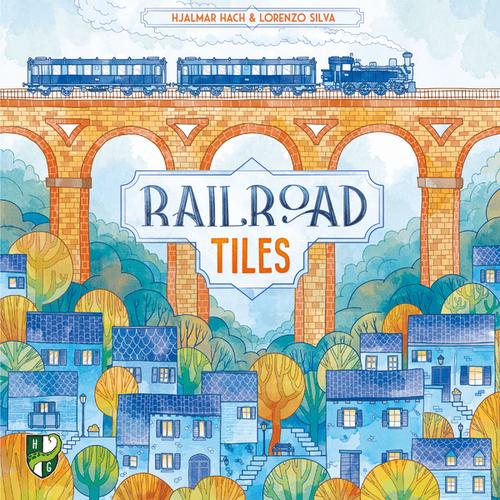




After the success of Railroad Ink, the series swaps dice for cardboard tiles in this drafting game from Hjalmar Hach and Lorenzo Silva. Published by Horrible Guild, the production quality is exactly what you’d expect: calming colours, clean artwork, and a satisfying finish. But how does it play?
All Aboard
To set up Railroad Tiles, build the station board and place it centrally so everyone can see. Choose a starting player and place them on the station’s first player space. Then, depending on player count, lay out the tile columns beneath the board.
Shuffle the round tokens and place them face down in the clock tower. Each player draws a starting tile from the bag, ensuring no duplicates between players.
After the success of Railroad Ink, the series swaps dice for cardboard tiles in this drafting game from Hjalmar Hach and Lorenzo Silva. Published by Horrible Guild, the production quality is exactly what you’d expect: calming colours, clean artwork, and a satisfying finish. But how does it play?
All Aboard
To set up Railroad Tiles, build the station board and place it centrally so everyone can see. Choose a starting player and place them on the station’s first player space. Then, depending on player count, lay out the tile columns beneath the board.
Shuffle the round tokens and place them face down in the clock tower. Each player draws a starting tile from the bag, ensuring no duplicates between players.
Return all tiles to the bag, give it a good shuffle, and you’re ready to begin.

City Planning
Unlike Railroad Ink, where everyone works from the same dice rolls, Railroad Tiles is all about drafting. Players choose from shared columns of tiles, meaning you won’t always get what you want. Turn order matters, adding a bit more interaction to the mix.
On your turn, you select a column of tiles from beneath the station board. Some columns contain two tiles, while the final stop offers four. Taking more tiles can be tempting, but there’s a trade-off: the more you take, the later you’ll play next round.
Once chosen, you place your tiles into your grid, making sure road and rail connections match and edges align. As your map grows, this becomes increasingly tricky. Tiles won’t always fit neatly into your plans, and you can quickly end up with awkward gaps, open-ended routes, or placements that do more harm than good.
You do have a small safety net, you can discard two tiles over the course of the game, but these don’t stretch far if luck isn’t on your side. It adds a welcome bit of bite to what is otherwise a fairly relaxing experience.
As the rounds go on, you become more invested in the map you’re building. Watching it evolve is part of the fun, whether you’ve created a looping road that goes nowhere, a surprisingly efficient network, or a sprawling layout that somehow lacks a single useful pinpoint. Sometimes your city ends up feeling more like a ghost town than a thriving network.

Making Tracks
Once everyone has placed their tiles, it’s time to score based on the round tokens. These move from the clock tower into the waiting room, becoming active as the game progresses. Tokens show pinpoints of pedestrians, cars, or trains, and you’ll score one of these types each round.
Scoring builds over time. Early on, you might only score a single pinpoint, but when that same token appears again later, you’ll score all matching connections in your network, up to a maximum of five. It creates a steady points engine, though getting it up and running isn’t always straightforward.
In practice, this can depend heavily on timing and availability. In one four-player game, the first two round tokens were both pedestrians, and I didn’t have a single one on my board. By the time it got back to me, most of the drafted tiles had no pinpoints at all, and in one round there wasn’t a single car, train, or pedestrian pinpoint available in any column. It made building early momentum difficult and, at times, a little frustrating.
To offset this, stars can be spent to ignore the current scoring condition and choose your own. These are limited, though. At the end of each round, any unchosen column gains a star, tempting players to take it next time. Unused stars are worth a point each at the end, so there’s a balance between short-term recovery and long-term scoring.
After eight rounds, players total their scores. Alongside round scoring, you’ll earn points for your largest rectangle, encouraging tight, efficient layouts. Connected cities also score, with three linked cities being the sweet spot. Finally, you’ll lose points for too many open road or rail connections, so sprawling networks can come back to bite you.
In short: draft tiles, build your network, and score as you go. It’s easy to pick up and breezy to play, though some may find it a little light.

Expanding the Network
Although the rules suggest playing the base game a few times before introducing objective tiles, it’s not something you need to stick to. These objectives add new ways to score and just enough complexity to make the game feel more engaging.
There are seven objective tiles in total. Each game, you’ll use three, with all players working towards the same set. During certain rounds, players will add one of their objective tiles to their map, and each completed objective is worth five points at the end.
They’re also nicely thematic. For example, one objective has you building around a station by placing three train symbols nearby, adding an extra layer to your planning.
Beyond this, there are already several expansions available, including Forest, Desert, Monuments, Countryside, and Lakes. These add more variety and help extend the game’s lifespan, which is always welcome in a tile-laying game like this.
If multiplayer isn’t your thing, there’s also a solo mode. This plays similarly to the two-player version, where you choose from a limited set of columns and remove others by flipping a token. While objective tiles aren’t included here, the game introduces small campaign-style challenges to work through instead.
These give you specific goals to aim for, and failing them means losing the game, adding a bit more focus to your decisions. With a playtime of around 30 minutes, it’s a great option when you want something relaxed but still engaging.

Final Thoughts
I don’t own many tile-laying games, but I’ve always been curious about the Railroad Ink series, so this was an easy one to try. What stood out immediately was the calming aesthetic and the satisfaction of building your own slightly odd but personal network.
That said, Railroad Tiles doesn’t reinvent the wheel. If you’ve played games like Sprawlopolis, Carcassonne, or Kingdomino, you’ll feel at home quickly. Despite its relaxed feel, it can become surprisingly thinky, especially at four players where choices tighten and desirable tiles disappear fast. This can lead to analysis paralysis and longer playtimes than expected.
There’s also a fair bit of upkeep. Between adding stars, moving round tokens, scoring, adjusting turn order, and managing setup changes at lower player counts, it’s easy to miss a step, and it can slow the pace.
One small drawback is the player colours. Most are very similar shades of blue, with only one standing out clearly. In practice, this made things tricky at times, especially for players who struggle with colour differentiation. It’s a minor issue, but one that could have been avoided with a bit more contrast.
Even so, I’ve enjoyed my time with it, particularly solo, where the game feels smoother and more relaxed. The objective tiles add a welcome layer of challenge, and I wouldn’t play without them.
Replayability is another strength. Between variable tiles, changing round tokens, and a growing list of expansions, each game feels a little different. It’s also easy to get to the table, sitting comfortably in that sweet spot between accessibility and depth.
Railroad Tiles is a chilled, spatial puzzle that looks great on the table and offers satisfying decisions throughout. It may not break new ground, but it refines familiar ideas into a clean, enjoyable experience. For me, the next stop is expansion city.

About the Author
Sophie is a gamer, blogger, podcaster, and book lover with a passion for solo narrative video games. When she's not immersed in games or writing, she's probably out hiking. Her favourite board games feature worker placement, nature themes, and smart tableau-building mechanics.