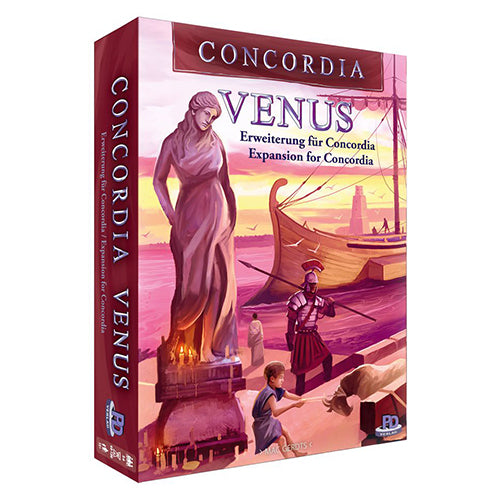
Venus is the second big-box expansion for Concordia – one of the all-time great games, and follows in the footsteps of the first expansion, Salsa. While it offers a few core things within the box itself, it also offers an additional, unquantifiable thing – opportunity! Let’s take a look.
Goddess on the mountain top
My Concordia collection is currently crammed into all three of the main boxes, so I’ve double and tripled-checked everything across the sprawling genealogy of this sprawling ancient Roman game. In the expansion box you’ll find:
Venus is the second big-box expansion for Concordia – one of the all-time great games, and follows in the footsteps of the first expansion, Salsa. While it offers a few core things within the box itself, it also offers an additional, unquantifiable thing – opportunity! Let’s take a look.
Goddess on the mountain top
My Concordia collection is currently crammed into all three of the main boxes, so I’ve double and tripled-checked everything across the sprawling genealogy of this sprawling ancient Roman game. In the expansion box you’ll find:
- A set of components for a 6th player – always nice
- Cards to allow for team play
- New Venus personality cards – including some new double-action cards and some with Venus herself introduced for end-game scoring
- A new map (of course)
- A card-display in two handy pieces
- A few more wooden resources and cardboard coins (to allow for the additional player)
Some of these need more explanation than others so let’s dive in with the simpler stuff first.
Burning like a silver flame
A sixth player set of components. Nice. This allows you to now choose white as your player in individual games, or as part of team play (which we’ll cover below). Concordia is a big game anyway so whether you’ll often choose to play with six individual players will be your own personal preference. But it does fit sensibly with the team version so you can have three teams of two slugging it out.
The new map is Hellas/Ionium which has the tighter, lower player count map of Hellas representing Ancient Greece with its capital Athens. Ionium is the more expansive higher player count map depicting the Ionian Sea.
While this isn’t specifically mentioned in the rules, I’ll give you a free tip (which is essentially borrowed from the standalone version of Concordia Venus). If you place the two-piece card market board on the left-hand side of the Ionium map, you’ll cover all the B cities and can reduce the size of the map to make it suitable for lower player counts. It’s a pleasing design consideration that this also covers the relevant bonus token slots at the same time.
Speaking of the card market, this is predominantly used for that Ionium map (Hellas has it pre-printed) and is double-sided to mix up the printed costs for personality cards by substituting most of the cloth costs for wine instead. This is just variation and is personal preference. If you’re keeping track, this was originally introduced in the additional Aegyptus/Creta map pack for original Concordia…
Someone really needs to make a diagram.
The summit of beauty and love

Let’s talk about team mode as there’s a few bits of detail that need attention here.
The mode itself allows you to play in pairs, and the new player pieces meaning you can do this as either 2v2 or 2v2v2. Simple enough so far. Setup has you sat in a repeated order (1-2-1-2 or 1-2-3-1-2-3) as you might expect. There’s an included orange turn order marker that you pass around so you don’t lose track of that. That’s important because…
…in teams, whenever you play a personality card, you and your team member will execute it, so taking into account their situation is going to be important here. There are a few tweaks to how certain cards function as well:
- Diplomat – you can’t copy the card of your team-mate, because they aren’t an opponent. Should make sense but worth calling out. In addition, you can’t both copy the same card of the same opponent so reading the board well becomes really important. Not only do you need to know what you need, but also have a sense of what your partner needs, and which cards currently out there would be most beneficial to them.
- Praetor – this is a new card specifically within Venus and specifically for team play. It replaces the Senator card which would normally allow you to purchase up to two cards for the row. Instead, each team-mate may purchase up to one card each and both transactions must be complete before the row is refreshed – no clever market manipulation here.
- Proconsul – another new card specifically for team play and replaces the new Consul card from the fully competitive mode (see below). This is a comparatively fiddlier card and lets you buy a single (non-Proconsul) card from the market and then allows your team-mate to play any card but only execute it for themselves.
- Legatus – another team only card, and again it feels a little contrived. You play your Legatus which means your team-mate can then play a card, but you get to inspect their hand and recommend one (which they may or may not choose to play), and then you both resolve the effect of that card.
There’s not much else to it mechanically, but I’d definitely say you need some degree of familiarity with that fully individual competitive mode before you dive into team play. There are no specific set rules about communicating with team-mates, but the instructions encourage you to set out what you’ll collectively allow before you begin and also suggests that more experienced teams be more limited in how they might communicate which is a nice touch and can help balance things a little.
And Venus was her name
Competitive play is my personal favourite way of playing but that’s mostly because I tend to play with smaller numbers of people so getting four people around the table and then introducing teams is a relatively rare thing. As with teams (above) we do have a few new cards:
- Magister – this allows you to copy your own previously played card (excluding Senators). It’s similar to the Diplomat except you’re only looking at your own cards here.
- Consul – a Senator-lite card. You can purchase a single card from the market but you only pay the cost indicated on the red banner on that card, ignoring any printed market costs. This can be a great way of getting higher cost cards on the cheap so well worth looking out for.
- Double action cards – this is a really neat feature that gives you a lot of flexibility. Cards are marked with two titles (e.g. Architect and Mercator) and you choose which of those two you want it to be when you play it. Having this early as an Architect allows you to get houses down early, but you can use it to get sestertii and trade later in the game if you want to. These are a subtle difference but can have a big impact on your gameplay. In team mode, whichever you pick when you play it also applies to your team-mate.
Finally we have Venus herself – added as one of the scoring deities in this version and is featured on the double action and Magister cards as well as the Legatus and Proconsul cards in team play. Venus scores points for every province you’ve built at least two houses in, so rewards not only expansion across the map, but concentrated expansion as you go. A tough order but lucrative if you can do it.
Yeah baby she’s got it

Opportunity that is. It feels like there are probably infinite ways to play Concordia now with the base game, Salsa, Venus and Solitaria as well as five additional double-sided map boards. All these things can be combined in some way – Venus has specific rules about what cards to add in/replace if you want to just play base game with Venus cards – but I think you possibly need a reasonable amount of patience at times to be able to do that.
I’ve played Venus with the fish market elements from Balearica which felt pretty seamless as a mash-up. Solitaria is pretty easy to integrate into either of the big box bits as well. I’ve not yet dared to play Concordia with Venus and Salsa together, but that time will come eventually.
If you have everything, there are 16 maps to go at before you start with variations like Venus cards and I think a game that is honestly this good is further enhanced by these subtle changes to how you approach it.
Final thoughts
I finalised my Concordia collection about a fortnight before Awaken Realms announced their big box, cool minis, new content version. I felt sad about that for a day or so, but I think the charm of Concordia in general is it’s cardboard and wooden components and I’ve not felt compelled to follow that.
Venus itself has a varying amount of stuff to offer depending on how you’ll most often play. If teams is a big draw for you then just do it now. It’s a whole new game mode in a way that’ll feel familiar to you. Big tick there.
If you’re more of an individual player, I think there’s still lots to offer with the different personality cards (the dual action ones in particular) as well as two maps and the compatibility with the original game itself!