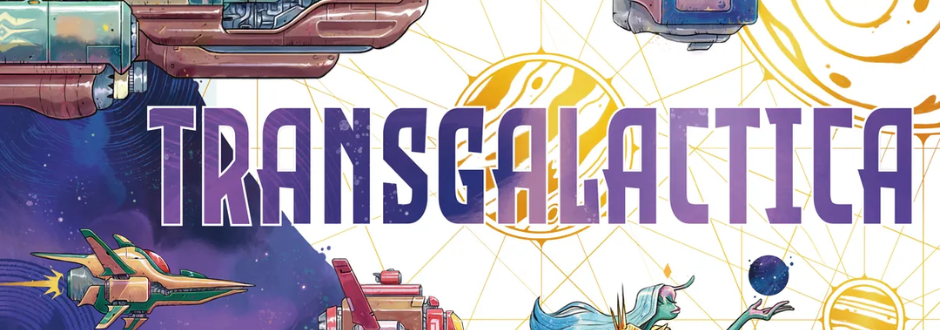
The galaxy is yours to explore, but with limited time and plenty of competition, every decision in Transgalactica matters.
In Transgalactica by Devir Games, you take command of your own fleet, sending your crew out into the galaxy to explore new worlds, gather resources, develop technology, and expand your influence. Across five rounds, you'll be building up your fleet and developing your various technologies, all while trying to make the most of the opportunities available to you.
Transgalactica is a 2–5 player strategic Eurogame that takes around 90 minutes to play. At its heart, it combines worker placement, resource management, and exploration with a clever system that allows other players to follow the actions you take. This creates an interesting balance between making the best move for yourself and considering what opportunities you're giving everyone else.
There is a lot going on in Transgalactica, but underneath all those moving parts is a game about making the most of limited opportunities. Every round presents you with more things you want to do than you have time and resources to accomplish, and working out which actions are worth prioritising is where much of the fun comes from.
What Kind of Game Is It?
At its core, Transgalactica is a worker placement game, but the way it handles that gives it a particularly interesting twist. Each player has two Captains and a number of Crew, and on your turn you send a Captain to one of the available action spaces around the board. This determines the main action you take, but it also opens that action up for the other players to follow with their own Crew.
Each round begins with a production phase, where your progress across the different tracks determines what resources and benefits you receive. As you develop your fleet and advance along these tracks, your production becomes more powerful, giving you more resources and options to work with in later rounds. It creates a satisfying sense of progression as the work you put in early starts to pay off.
There are a range of actions available, covering everything from exploring new planets and mining resources to trading, developing technology, producing goods, and improving your military and political influence. Each one develops your fleet in a different way, and working out how these actions fit together is a big part of the puzzle.
The Captain and Crew system is where much of the game's interaction comes from. When you choose an action, other players have the opportunity to follow you, usually gaining a slightly weaker or more expensive version. This means your decisions are never entirely your own. You might have the perfect move available, but if it gives another player exactly the opportunity they need, you have to decide whether the benefit to you is worth helping them as well.
Exploration adds another layer, with planets providing new opportunities and resources as you expand across the galaxy. Meanwhile, the various tracks, objectives and scoring opportunities give you reasons to pursue particular strategies rather than simply trying to improve everything at once.
What makes Transgalactica particularly interesting is that there is rarely enough time to do everything you want. With only five rounds to develop your fleet, every action has an opportunity cost. You might desperately want to explore, but perhaps the Technology track needs attention, or you need resources for an important upgrade. Learning when to focus on one area and when to take advantage of an opportunity elsewhere is where much of the game's strategy lies.
First Impressions
My immediate reaction when I opened Transgalactica was, “Wow, that's a lot of pieces,” followed fairly quickly by, “Wow, that's a lot of stickers that I now have to put on those pieces.”
The game comes with a huge number of wooden components, with almost all of them needing stickers applied to both sides. What followed was a good two-plus hours of peeling stickers from a sheet and meticulously applying them to the various pieces, only to then have to replace some when I wasn't happy with the positioning.
The cylindrical outpost pieces were particularly fiddly, as the stickers didn't seem to want to stick properly to the painted wood. Eventually, I had to resort to using additional glue to get them to stay in place.
The rulebook does point out that the stickers aren't necessary to play the game, but personally, I think they're worth the effort. They massively elevate the overall look of the game and make some of the pieces much easier to recognise. That said, with so many pieces to sticker, it would have been nice if they had been pre-stickered or had the designs printed directly onto the wood. I'm aware that either option would have added to the production cost and ultimately the price of the game, but it would certainly have made that initial setup much less daunting.
Once that mammoth task was finally finished, though, I was really happy with how everything looked. The bright colours and artwork give Transgalactica a fantastic visual identity, with different alien species bringing a vibrant and dynamic feel to the table. When everything is laid out, it really does look like a big space adventure.
The first setup was another story. There are a lot of steps to work through, with numerous tracks, cards, boards and pieces all needing to be put in their correct places. It was definitely daunting the first time around, although familiarity makes this process much quicker. I also really like that the game uses different board sides, with an additional board depending on player count, helping it adapt to different group sizes.
The iconography initially looked overwhelming simply because there is so much of it. I did find myself referring back to the rulebook whenever I couldn't immediately recognise something, but overall it was easier to understand than I initially expected.
The rulebook itself is substantial, and with so many different tracks, actions and systems to learn, getting through the initial teach can feel like a challenge. However, once you actually start playing, the rhythm of Transgalactica quickly begins to emerge. Those intimidating systems start to make more sense as you interact with them, and before long, everything begins to click into place.
Gameplay Experience
After the initial learning curve and the inevitable first round of asking myself, “Am I actually playing this right?”, the gameplay loop of playing a Captain and then deciding whether to follow an action with one of your limited Crew felt really good.
The fact that only one Captain can visit each action space per round makes you constantly think about what you need to do yourself and what you might instead be able to follow. Having the opportunity to produce important resources and victory points at the start of each round also felt massive to me. I often found myself lacking what I needed for certain actions, so investing in production became an early priority.
With only five rounds, production is both quick and limited, and the more Crew you have, the less you produce. This created an interesting balancing act, as I wanted enough Crew available to follow other players' actions while also trying to maximise my production.
That becomes even trickier when you start gaining seats on the Council. These give you points, but permanently remove a Crew member, meaning you have to weigh up the immediate scoring opportunity against losing one of your most useful resources for future rounds. Crew can only be gained back by reaching certain spaces on the different tracks, so I found myself thinking carefully about when it was worth committing them.
Having two main Captain actions each round, or three in a two-player game, also gives you a real sense of urgency. There are plenty of things you want to accomplish, but only so many opportunities to do them. One of the planets even allows you to perform any other action on the board, making planning ahead even more important.
The Follow mechanic is a lot of fun as well. If another player takes the action you wanted, you're not completely locked out. You can still use one of your Crew to follow them, although you'll generally get a slightly weaker or more expensive version. Do you take the less efficient option, or pivot and focus on something else this round? I found myself constantly adapting my plans based on what the other players were doing.
This also means there isn't a huge amount of downtime. Even when it's another player's turn, you're still paying attention and deciding whether you want to follow them.
The different tracks add another layer to deciding where to focus. Politics allows you to gain Missions while increasing your Mining and Production thresholds. Technology provides useful powers and end-game scoring opportunities, while Military is important because the player at the top gains victory points each round and the player at the bottom loses them. Then there's the Trade track on your personal board, which gradually increases and unlocks additional Income spaces.
With so many things competing for your attention, deciding what to prioritise can be surprisingly tricky. You quickly realise that you can't maximise everything, so you have to find the areas that work best together and build your strategy around them.
Exploration was probably the part of the game that felt the least exciting to me, although it still plays an important role. There are planets to colonise that provide different rewards, from mining benefits to additional production, alongside planets that provide additional action spaces for your Captains. There are also pirates to overcome, which can improve your production phase.
The main cost of exploration is Energy, and you also need to make sure you've progressed far enough along your Trade track before you're able to colonise some planets, so even exploration ties back into the wider progression of your fleet.
The first round can feel quite overwhelming because there is so much you want to do while your ability to accomplish those things is still fairly limited. As the rounds progress, though, you start powering up and your options become much broader. Tracks improve, production increases, you gain access to more abilities and your fleet becomes increasingly capable.
I also enjoyed how much the game asks you to adapt. You can start a round with a clear idea of what you want to achieve, only for another player to take the action you needed. At that point, you have to decide whether to spend a Crew member following them or change your plans entirely.
There are also plenty of ways to earn points, whether through production, end-game Technology, the Military track, Council seats or Missions. It never felt like there was one obvious route to victory. Instead, you can score through several of these areas during the same game and find different combinations that work together.
The more I played, the more I appreciated that flexibility. You're not simply following a predetermined strategy; you're constantly looking at what is available, what your opponents are doing and where you can get the most value from your limited actions.
I have played at different player counts, and while the two-player game works, it can sometimes feel like you're simply bouncing back and forth between two players. With more players, there are more opportunities to follow actions, more competition for the available spaces, and generally more happening around the table. For me, Transgalactica becomes a more interesting experience as the player count increases.
Overall, the gameplay feels like a constant balancing act between what you want to do, what you can afford to do, and what your opponents are allowing you to do. It can be overwhelming at first, but once the different systems click, there's a lot of satisfaction in finding your own path through the galaxy.
Who Is It For?
Transgalactica is definitely a game for people who enjoy sitting down with a heavy Euro and getting stuck into it. This isn't a game for someone looking for something light or something they can pull off the shelf and be playing within ten minutes. There's a substantial setup, a lengthy teach and plenty of systems to understand.
Interestingly, though, Transgalactica feels heavier than it actually plays. The biggest hurdle is getting your head around all the different concepts, tracks and actions. Once that initial learning curve is out of the way, the actual gameplay becomes much more straightforward.
The bigger challenge comes from planning ahead while still adapting to your opponents. You can have a perfect plan for your round, only for another player to take the action you were relying on. Being able to adjust rather than stubbornly sticking to your original plan is a big part of playing Transgalactica well.
I would also recommend playing with more players if possible. Two players is a perfectly reasonable way to learn the game, but it feels noticeably different with a larger group. At five players there is far more happening around the board, with more opportunities to follow actions and more competition for spaces. For me, that's where Transgalactica really comes alive.
If you're a fan of science-fiction games, Transgalactica should fit nicely into your collection. The theme is felt throughout, with your actions consistently reinforcing the idea that you're managing a crew of aliens, travelling across the universe and developing your fleet. Even as someone who wouldn't normally choose a space setting over fantasy or nature, I found the theme worked surprisingly well.
The five rounds also go by much quicker than you might initially expect. For me, the longest part of the experience was the teach, particularly when I had to keep referring back to a rulebook that could occasionally feel confusing. Once you're playing, actions themselves are fairly quick, although the Follow mechanic can naturally extend turns.
The recommended playtime of 90 minutes feels achievable, but I could certainly see games stretching beyond that at higher player counts. Even so, I never felt like my games overstayed their welcome.
Ultimately, Transgalactica is best suited to a group that enjoys heavier strategic games and doesn't mind putting in the work before getting the most out of them. The initial barrier is certainly there, but once you've crossed it, you're left with a surprisingly fluid game that I can see myself regularly reaching for with the right group.
Highlights & Drawbacks
Transgalactica's biggest strength for me is its Captain and Crew system. The ability to follow another player's action keeps everyone involved and creates some great decisions around when to take an action yourself and when to let someone else open the opportunity for you. Combined with the number of different scoring routes, it gives the game plenty of strategic flexibility.
I also really enjoyed the sense of progression across the five rounds. Starting with limited options before gradually unlocking more production, technology and opportunities makes the later rounds feel noticeably more powerful and rewarding.
The biggest drawback is the initial barrier to entry. There's a lot to learn, the rulebook can be confusing at times, and the sticker application is a considerable undertaking. Once you're past that, the game flows much more smoothly, but getting to that point requires some commitment.
I'd also recommend playing with more players if possible. Two players works well for learning, but the game feels considerably more engaging with a larger group, where the Follow mechanic and competition for action spaces really come into their own.
Final Thoughts
Transgalactica surprised me. I'm not usually drawn to sci-fi games, and the sheer amount of components, tracks and rules initially made it feel like a daunting experience. Once that learning curve was out of the way, though, I found a much smoother and more rewarding Eurogame underneath.
What I enjoyed most is the freedom of choice. There are plenty of ways to develop your fleet and score points, but with only five rounds, you have to carefully decide what to prioritise while constantly adapting to your opponents. The Captain and Crew system is particularly effective here, keeping everyone involved and making your opponents' choices just as important as your own.
It isn't the easiest game to get into, with a lengthy setup, fiddly sticker application and a rulebook that can be confusing at times. But once you're past that initial hurdle, the game flows surprisingly well, and the five rounds disappear much quicker than expected.
I'd definitely recommend it with more players, where the competition for actions and opportunities to Follow really come alive. For fans of heavier Eurogames, Transgalactica offers a lot to sink your teeth into, and despite not normally being a sci-fi fan, it's a game I can see myself returning to with the right group.