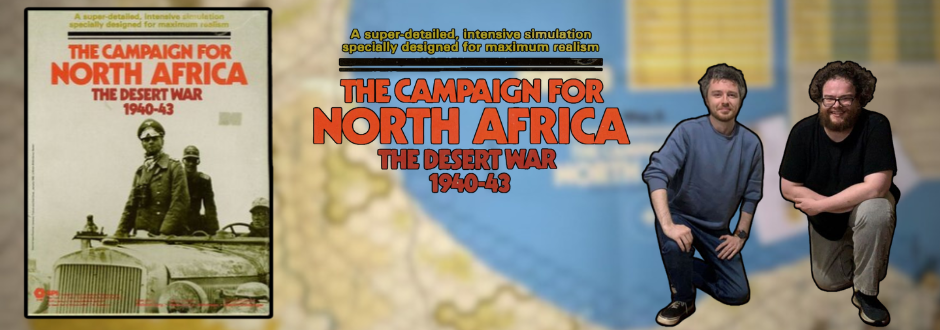
Two friends have spent two years playing a tutorial for one of the most notoriously complicated war games ever made. It felt like a distant dream then, but now, they're preparing to tackle the full campaign, and they're already questioning their life choices...
A board game that makes World War Two look quick
The Campaign for North Africa has earned a reputation as one of the most demanding board games ever designed. Set during the North African campaign of World War Two, the game features an astonishing level of military detail, with rules covering everything from supply lines and aircraft to water consumption. The game's full campaign consists of 50 turns and can take significantly longer to complete than the historical events it recreates. In fact, nobody has officially beaten the entire game, making it a formidable challenge for even the most dedicated tabletop enthusiasts.
Andy and James, two friends from England, are determined to change that. The pair have already completed the game's six-turn tutorial, playing together every week for two years. They document their progress on their podcast, War with a Mate, which has become an important part of keeping their ambitious project alive. Having spent so long learning the ropes, they're now preparing to begin the full campaign. However, finishing it could take decades rather than years. James estimates that 20 years is a reasonable timeframe, admitting that he struggles to think of anything else he's consistently maintained since childhood. The game looks set to become a permanent fixture in both players' lives!
The rulebook is an enemy of its own
One of the biggest challenges isn't necessarily defeating the opposition. It's understanding what the rules actually mean. Originally published in 1978, The Campaign for North Africa is packed with intricate systems and detailed procedures. Unfortunately, that level of detail doesn't always make things clearer, with some rules leaving the players scratching their heads. Andy recalls a particularly bizarre example involving the game's camel units. The rules apparently prohibit transporting live camels by air while allowing dead camels to be transported. However, they don't explain how players should determine whether a camel is dead, let alone why anyone would want to load one onto an aircraft.
It's an absurdly specific problem, but it's representative of the difficulties the pair face throughout the game. Hours can disappear into interpreting individual rules, checking calculations and trying to work out exactly what the designers intended. And that's before the fighting even begins!
Is it actually fun to play?
Despite the game's reputation and the commitment required to tackle it, the obvious question is whether Andy and James are enjoying themselves. Andy's answer isn't exactly an enthusiastic endorsement.
"The amount of work you have to put in to get the small nuggets of fun aren't quite congruent," he explains.
Much of their time is spent managing supplies, organising logistics and maintaining spreadsheets. Moments of exciting action are often separated by hours of administrative work, making progress feel painfully slow.
As Andy puts it, "It shouldn't be fun, and it's not".
Yet there's something compelling about the experience. Both players joke about developing Stockholm syndrome, finding themselves missing the game during breaks despite frequently complaining about it while playing. Combat can feel like the most exciting thing they've experienced in weeks, even if those encounters might seem fairly ordinary outside the context of the lengthy preparation required to reach them.
For James, the satisfaction comes from watching long-term plans finally pay off. Positioning vehicles, organising supplies and preparing for an offensive can take weeks of real time. When everything comes together, the reward feels earned. Of course, the reverse is also true. A plan that falls apart because of a misunderstood rule can be devastating after months of preparation.
Andy recalls one particularly frustrating moment when an entire strategy depended on a rule that didn't work as he'd expected. He describes walking away from the board in anger, questioning whether continuing was worth the effort. It's a remarkable amount of emotional investment for a game that frequently seems determined to make its players miserable!
A podcast keeping the campaign alive
Fortunately, the pair have an additional reason to keep going: their podcast. War with a Mate began as a way to document their progress, but it has developed into an accountability tool. Knowing that listeners are following their journey makes abandoning the challenge that much harder. The podcast has attracted close to 30,000 listeners, according to the pair, with much of its audience apparently coming from Australia.
That support could prove particularly valuable as they move into unfamiliar territory. Their two-year tutorial has helped them understand many of the game's systems, but it hasn't prepared them for everything the full campaign introduces. James points to the Commonwealth's production system as one major example. It requires players to plan well in advance, with decisions potentially needing to be made two months before their consequences arrive. Their six-turn practice campaign never reached that stage, leaving an entirely new set of mechanics to learn. Andy faces his own learning curve on the Axis side. The German forces don't enter the game until around turn 27, meaning he'll have plenty of unfamiliar units and systems to deal with when they finally arrive.
One torpedo, decades of planning
Perhaps the funniest detail concerns one of the game's most powerful opportunities. The Axis receives a torpedo strike ability that can be used just once during the entire campaign. After years of preparation and potentially decades of play, Andy will have a single chance to make it count.
"I'll need to really pick my moment for that," he says, adding that he'll be in tears if the attack fails.
It's a fitting summary of The Campaign for North Africa: enormous amounts of planning, painfully slow progress and the occasional moment of high-stakes excitement. Andy and James still have the full 50-turn campaign ahead of them, and there's no guarantee they'll reach the finish line. But with two years of practice behind them and a growing audience following their progress, they're ready to find out just how far their commitment can take them. If they succeed, they'll have accomplished something remarkable. If they don't, at least they'll have plenty of spreadsheets to show for it!