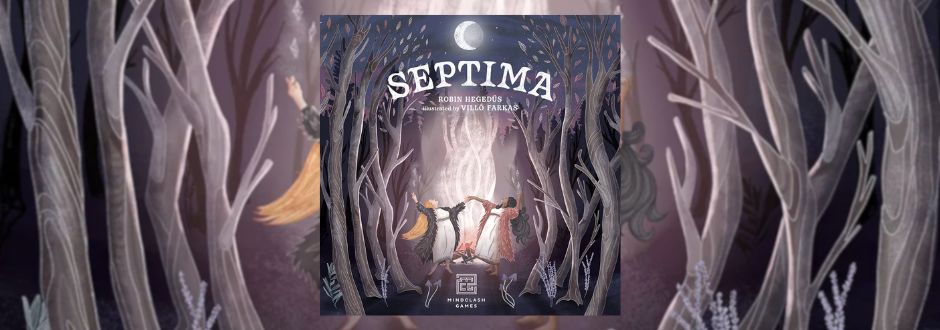

Witchcraft, Suspicion, and the Constant Feeling That You’re About to Be Caught
Most worker placement games make you feel efficient.
Septima makes you feel nervous.
Not immediately, though. At first, the game looks almost comforting. You’re gathering herbs, healing villagers, brewing potions, moving around a beautifully illustrated town with your little coven of witches. It has that polished, slightly magical presentation Mindclash Games tends to do very well.
Then the hunters start moving.
And suddenly every decision feels just a little less safe.
That shift is what stayed with me most after a few plays. Septima spends the early game letting you settle into its systems, and then quietly starts tightening the pressure around them.
The Core Idea Is Surprisingly Elegant
At its heart, Septima is actually fairly straightforward.
Each round, players secretly choose an action card. Everyone who picked the same action performs it together, which strengthens the effect. That sounds great in theory because stronger actions are obviously useful.
The problem is that stronger magic also attracts suspicion.
And suspicion is dangerous.
The more openly you cooperate with other witches, the more attention you draw from the hunters wandering around town. Get caught in the wrong place at the wrong time, and your witches can end up exposed or even captured.
So the game constantly pushes you into this awkward little dilemma: do you play safely and weaker, or risk a bigger turn and hope the hunters don’t end up exactly where you need to be?
It’s a really smart tension for a game built around witchcraft.
The Shared Action System Carries the Whole Experience
What makes Septima feel different from a lot of euro-style games is how much uncertainty exists around the table.
Normally in worker placement games, you mostly focus on optimising your own sequence of actions. Here, you’re also trying to predict what everyone else might choose because overlapping actions become significantly stronger.
There’s a strange little moment every round where players reveal their chosen cards and immediately react to what everyone else picked. Sometimes you feel clever for aligning with another player perfectly. Other times you realise you’ve accidentally made yourself the most suspicious witch in town.
And because the hunters react dynamically, those reveals matter.
The game becomes this weird balance between cooperation and self-preservation where players constantly benefit from each other while also quietly hoping someone else gets blamed instead.
Honestly, it captures the theme far better than I expected.
The Hunters Add Constant Pressure
The hunters are probably the best part of the game.
Not because they’re complicated as they aren’t, but because they change the emotional texture of every turn. You can usually see danger coming, but rarely with complete certainty. That uncertainty makes otherwise simple actions feel riskier than they actually are.
Moving into the wrong district at the wrong moment suddenly becomes a real decision. Healing villagers publicly might help your long-term goals while also making you incredibly visible. Even performing a powerful action can feel slightly uncomfortable once suspicion starts climbing.
The game never lets you settle completely.
There’s always this background feeling that things could go wrong if you push too hard.
The Table Presence Is Incredible
This thing looks fantastic.
The oversized witch miniatures, the rotating rondel, the layered town board all of it creates a really strong atmosphere before the game even begins. Mindclash clearly understands how important presentation is for a theme-heavy game like this.
And unlike some heavily produced games, Septima actually benefits from that presentation because the visual state of the town matters constantly. You’re tracking where hunters are moving, where witches are gathering, where suspicion is building.
The board stays readable despite everything happening on it.
That’s harder to pull off than it looks.
It’s More Interactive Than Most Euros
What surprised me most is how much attention you pay to other players.
You’re constantly watching: where witches are moving, which actions seem likely, who’s building suspicion too quickly, and who might accidentally drag you into danger.
The interaction never feels openly aggressive, but it’s always present. Sometimes you actively want another player to match your action because the bonus is worth the risk. Other times you desperately hope nobody chooses the same thing as you because the hunters are already nearby.
That uncertainty creates a really interesting table dynamic where players are indirectly influencing each other almost every round.
The Game Can Feel Dense at First
Septima definitely has a learning curve.
Not because any individual system is especially difficult, but because there are several moving parts interacting at once: action selection, suspicion, hunter movement, potion brewing, healing, saving witches, progression, and endgame scoring.
The first game can feel slightly overwhelming simply because players don’t yet understand which systems matter most in the moment.
Once the flow settles in though, the game becomes much smoother than it initially appears.
A lot of the complexity comes from understanding consequences rather than memorising rules.
The Theme Actually Matters Here
A lot of euro games wear their themes fairly loosely.
Septima doesn’t.
The tension between helping the town and avoiding persecution genuinely shapes how you play. The mechanics reinforce the feeling that witches are powerful, useful, and constantly under threat all at once.
You feel cautious in ways that fit the theme naturally. You hesitate before taking stronger actions. You watch the hunters carefully. You quietly celebrate when suspicion falls away from your coven.
That emotional consistency carries the game a long way.
Final Thoughts
Septima is one of the more interesting euro-style games I’ve played in a while because it doesn’t just ask players to optimise systems.
It asks them to manage visibility.
The game constantly tempts you into stronger actions while quietly reminding you there might be consequences attached to them. That tension runs through almost every round, and it gives the entire experience a sense of pressure that most worker placement games never really reach.
It’s not the cleanest or simplest game Mindclash has made. The first play especially can feel like a lot.
But once the systems start connecting properly, Septima creates a really memorable atmosphere one where every powerful turn feels slightly dangerous.
Which, honestly, feels exactly right for a game about witches.
Snapshot
Overall Rating
- 72 / 100
Sub-Ratings (Out of 5)
- Artwork: 5/5
- Complexity: 4/5
- Replayability: 3/5
- Player Interaction: 4/5
- Component Quality: 5/5
What I Loved
- Shared action system creates constant tension
- Strong thematic integration
- Beautiful table presence
What Fell Flat
- First few games can feel overwhelming
- Some systems take time to fully appreciate
- Downtime can appear with slower players
- Endgame scoring isn’t immediately intuitive