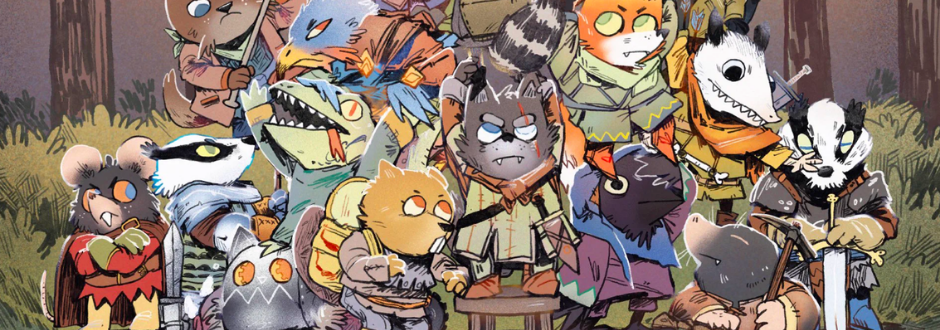
Root: A Game of Woodland Might and Right is largely considered a household name, renowned for its deceptively cute art style, which has tricked countless casual gamers into purchasing a game of complex, asymmetrical, and ruthless warfare in which the key to victory is knowing your opponents’ factions as well as your own. Here is my power ranking of each of the 10 factions, excluding the recently released Homeland Expansion, based on their strengths and weaknesses, since not every creature is created equal in the Woodland!
10. Marquise de Cat

The Marquise arrives in the Woodland with the largest presence and the most warriors, ready to seize control with its workshops, sawmills, recruiters and towering keep. In essence, it is the simplest faction with a straightforward process of moving and building; yet, its finite action economy and slow scoring, dependent on wood production, frequently cause it to stagnate in comparison to the other, more dynamic factions. Furthermore, the Marquise needs to build, and in turn protect, a growing number of buildings to score, which appear as cat-shaped piñatas full of points to other factions. Finally, it is the only faction that can be completely removed from the game!
The Good
- Substantial starting board presence with a large warrior supply
- The ‘Field Hospitals’ ability makes removing Marquise warriors difficult as long as it has cards to burn
- A guarded keep that prevents others from placing any pieces in its clearing
The Bad
- A limited action economy with only three actions (without bird cards)
- Slow and predictable scoring that relies on the production of wood, a chain of controlled clearings, and available building slots
- The large quantity of buildings and wood pieces makes the Marquise an easy and valuable target
The Ugly
- Having to rely on the pity of other players to leave the Marquise alone
9. Lizard Cult

The Lizard Cult hopes to convert the outcast denizens of the Woodland into cult members through various conspiracies and rituals enacted at their precious gardens. A complex and passive faction that is considerably dependent on the actions of other players and luck! The cards the Cult draws will dictate in which clearings it can recruit, build gardens and score points. On the other hand, all discarded cards influence its outcast suit, allowing it to perform conspiracies in outcast clearings, the only way it can move or battle. However, these two aspects rarely align, often forcing the Cult to operate inefficiently and fall behind its opponents.
The Good
- Powerful conspiracies that allow the Cult to convert other factions' warriors/buildings into its own
- The ‘Revenge’ ability generates acolytes required for conspiracies faster by automatically converting removed defending Cult warriors into acolytes
- Card wealthy, able to simply reveal cards to perform actions
The Bad
- Limited autonomy, as the Cult relies completely on the outcast suit for performing conspiracies and crafting
- Slow scoring that requires having enough gardens and discarding cards matching the gardens’ suit
- Each destroyed garden discards a random card, drastically reducing the Cult’s action economy
The Ugly
- The outcast suit frequently prevents the Cult from actively participating in the game or even defending its own gardens
8. Corvid Conspiracy

The Corvid Conspiracy seeks to sow chaos and anarchy throughout the Woodland with its hidden plots and devious schemes. A flexible faction that relies heavily on the player’s ability to deceive, trick, and misdirect opponents. The effects of the Conspiracy’s plots are potentially harmful to other factions and score exponentially more points with each reveal, so it must carefully consider where it places them, how other factions perceive its presence, and remain inconspicuous for the majority of the game to divert attention elsewhere. The Conspiracy is not a particularly powerful faction, but it has various tools at its disposal to disrupt other factions’ plans.
The Good
- Flexible playstyle that allows the Conspiracy to recruit, move and battle easily
- Capable of scoring rapidly by revealing multiple plots at once
- Each plot type has a special ability that benefits the Conspiracy and hinders its opponents
The Bad
- The ‘Exposure’ ability enables opponents to try to guess a hidden plot and prevent its reveal effects
- A restricted action economy with just three actions, and doing a fourth action skips the card drawing step
- The Conspiracy’s modest warrior supply can be stretched thin, as existing plots require protection and placing new plots removes Conspiracy warriors
The Ugly
● Opponents can collectively expose all of the hidden plots, completely preventing the Conspiracy from revealing them
7. Riverfolk Company

The Riverfolk Company profits from the conflict by offering its services to anyone and everyone while establishing trade posts throughout the Woodland. After all, war is good for business! A dynamic faction that solely depends on the player’s ability to sell their cards, riverboats and mercenaries in exchange for other factions’ warriors. The Riverfolk prefer to build trade posts and craft items for points, but the speed with which they operate is determined by the amount of funds at their disposal. If not scoring quickly enough, the Riverfolk can always pivot to go on the offensive and relentlessly attack the factions that are outscoring them.
The Good
- Growing action economy since Riverfolk’s funds are used to perform actions and generally kept between rounds
- Strong card economy and crafting, including the ability to draw cards as an action and craft using even destroyed trade posts
- Swift scoring potential through establishing trade posts and crafting items
The Bad
- Reliant on convincing other players to buy their services
- Other factions’ warrior supplies affect their capability/willingness to purchase from the Riverfolk
- Recruiting Riverfolk warriors is costly, as it requires permanently spending funds
The Ugly
- If opponents never choose to buy any Riverfolk services, it severely stunts the Riverfolk’s growth and limits their capabilities
6. Lord of the Hundreds

The Lord of the Hundreds intends to bend the Woodland to its will by looting items to grow its hoard and burning anyone in the way using its destructive mobs. An extremely aggressive and active faction whose main focus is destroying other players’ presence and solely controlling as many clearings as possible. The Warlord’s ever-changing moods give it a unique ability each turn, and the items in its hoard expand its action economy, making it powerful and versatile. However, the Warlord’s scoring tends to be slower than that of other factions, forcing it to stay on the offensive and burn everyone else to the ground.
The Good
- The Warlord’s moods provide distinct effects that allow for an adaptable approach
- The ‘Command’ and ‘Prowess’ actions offer a robust action economy centred on movement and attacking
- Strong recruiting capability, featuring free recruitment at the Warlord’s clearing and every stronghold
The Bad
- Slow and demanding passive scoring that requires constant removal of enemy pieces in the Warlord’s clearings
- Weak card economy and crafting, largely because its card drawing cannot be permanently improved
- Each unique item in the hoard blocks one of the Warlord’s moods, restricting its options
The Ugly
- The warriors are the Warlord’s lifeline; therefore, removing them, the Warlord, or Strongholds can utterly kill its momentum
5. Keepers in Iron

The Keepers in Iron are on a ceaseless crusade throughout the Woodland, delving for lost relics and recovering them for their ancient order. The faction is widely considered the most difficult, requiring extensive planning to play successfully. To build momentum, the Keepers ideally rule the clearings where they delve for or recover relics, necessitating frequent recruitment, movement and combat. Fortunately, they are gifted on all those fronts, as long as they plan their actions in advance and build a strong retinue. If left unchecked, the recovery of their relics can outscore most other factions.
The Good
- Buildable and flexible action economy based on cards added to the Keepers’ retinue
- Strong card economy and crafting, as their waystations may be easily built/removed anywhere there is a Keepers warrior
- The ‘Devout Knights’ ability strengthens the Keepers’ defensive and offensive capabilities
The Bad
- Each delve or recover action may result in the loss of a card from their retinue, reducing the Keepers’ action economy
- The ‘Prized Trophies’ ability encourages other factions to prioritise destroying the relics
- The ‘Live Off the Land’ step discourages the Keepers from having a large army in a single clearing, making it harder to defend relics
The Ugly
● The attacker returns destroyed relics to any forest, naturally putting them out of the Keepers’ reach
4. Woodland Alliance

The Woodland Alliance rebels against the system by spreading sympathy among the denizens of the Woodland and revolting in enemy territory. This unassuming faction begins the game with no presence on the board, but can rapidly snowball out of control and is always capable of making a comeback. The Alliance's primary scoring method is placing sympathy tokens in as many clearings as possible using its deck of supporters. It benefits from other factions interacting with sympathetic clearings and giving it cards to spread further sympathy, making it nearly impossible to suppress the Alliance completely; instead, it typically grows stronger than before.
The Good
- The ‘Outrage’ ability forces other players to supply the Alliance's supporters deck
- Strong crafting and scoring potential through Sympathy tokens that the Alliance regularly places
- The ‘Guerrilla War’ ability makes attacking the Alliance difficult, even when it has fewer warriors
The Bad
- Clearings with ‘Martial Law’ make spreading sympathy more expensive and might restrict the Alliance’s options
- Destroying a base eliminates officers and supporters, drastically slowing the Alliance’s momentum
- Without a base, the Alliance can’t use their evening actions and is limited to only 5 supporter cards
The Ugly
- Opponents can keep removing all the sympathy tokens, potentially never letting the Alliance build a base, to severely restrict its growth
3. Eyrie Dynasties

The Eyrie Dynasties strive to restore their claim to the Woodland and regain their former glory as the lords of the forest. A systematic faction that primarily scores passively based on the number of roosts it has built; however, it must manage an ever-expanding decree that dictates the location and number of recruit, move, battle and/or build actions it must perform every turn. Developing and maintaining an efficient decree allows the Eyrie to extend and dominate other factions; yet, it is constantly at risk of turmoiling, which forces it to lose points and restart its entire decree.
The Good
- The decree enables the Eyrie to build a large and versatile action economy, with limitless recruiting, moving, battling and building
- The ‘Lord of the Forest’ ability greatly assists the Eyrie in completing its decree
- The Eyrie’s different leaders give it various powerful abilities
The Bad
- The Eyrie must be extremely careful about the cards and their position in the decree, as it might lead to turmoil
- Turmoil resets the decree and ends the Eyrie’s turn, affecting its momentum and action economy
- Weak crafting potential, as most of its cards go into the decree and ‘Disdain for Trade’ makes items less valuable
The Ugly
- Turmoil makes the Eyrie the only faction that can lose points
2. Vagabond

The Vagabond wanders the Woodland alone in search of items, forming alliances and rivalries with the other factions, and completing quests to increase its renown. Uniquely, at the beginning of the game, a player selects a single Vagabond character to play, each with its own set of starting items and a special ability. A one-man band, the Vagabond pivots between aiding and hindering its opponents while entertaining several different scoring avenues; shifting between them is crucial to maintaining its momentum. However, its ability to score an extra point for each hostile piece removed is widely considered excessively generous, rendering aggressive Vagabonds, wielding multiple swords, a significant threat in the game.
The Good
- Strong scoring potential and adaptability, with numerous ways to get points
- Solid action economy that steadily grows with each item acquired
- The Vagabond is an unappealing target, as attacking it offers no point reward, and it can repair all of its items by spending a turn in a forest
The Bad
- Completing quests is situational and often inefficient, as it slows the Vagabond’s action economy by exhausting essential items
- The Vagabond’s momentum suffers if its items are damaged or its opponents don't craft any items
- As a singular unit, the Vagabond has no board control or presence, leaving other factions with more room to expand
The Ugly
- The different Vagabond characters require a power ranking of their own because their individual viability varies greatly
1. Underground Duchy

The Underground Duchy believes the surface dwellers should be ruled from the burrow below, demonstrating its aristocratic superiority through its assembly of ministers. The Duchy’s strategy relies on swaying various ministers to support its cause, as each swayed minister contributes a unique service to its action economy. A competent faction that can become a militaristic powerhouse by building citadels, a card-drawing and crafting machine by building markets, or a hybrid of the two. Alternatively, an effective strategy involves the Duchy not constructing any buildings initially and focusing primarily on swaying ministers until it has enough actions and points to steamroll the other factions.
The Good
- Robust scoring potential and action economy, which grows with each newly swayed minister
- Strong recruitment, card drawing, and crafting capability, improved with every citadel and market built
- Excellent mobility, as digging tunnels allows the Duchy to emerge from the burrow in force at any clearing
The Bad
- The ‘Price of Failure’ ability can significantly disrupt the Duchy’s action economy
- The Duchy’s card economy can be stretched thin as it needs cards to place buildings, dig tunnels and sway ministers
- The necessity to protect its buildings from the ‘Price of Failure’ may restrict the Duchy’s influence on other clearings
The Ugly
● The Duchy’s faster scoring and mobilisation motivate opponents to play whack-a-mole, relentlessly attacking it to keep it from outpacing everyone else