Give me a map full of islands and I'll naturally assume that the difficult part of the game will be deciding where to go. There will be territory to claim, perhaps a few disagreements with the neighbours, and hopefully a reason to build a boat.
Six Sojourns has all of that. What I didn't expect was for the more pressing concern to be whether I could afford the card that would let me do any of it. Ryan Laukat returns to the world of Arzium in a reimagining of Eight Minute Empire, his wonderfully economical little area-control game. The original built an entire contest for territory around a handful of card purchases. Six Sojourns retains that foundation but gives the cards considerably more to do, while introducing new ways to score and a collection of optional modules. It also retains one of the original design's most appealing restrictions. You get nine turns, purchasing exactly one card on each. Once everybody has nine cards, that's the game.
I find that an appealing proposition. There are plenty of games where I enjoy watching a strategy develop over several hours, but there's also something satisfying about being given a limited number of opportunities and having to make the most of them. The interesting thing about Six Sojourns is that those opportunities aren't necessarily spent doing what the board seems to be encouraging you to do.
A Shopping Problem Disguised as an Empire
The card market deserves attention before anything else because it determines practically everything that follows. Five cards are displayed in a row, costing anywhere from zero to four coins. Whenever somebody purchases one, the remaining cards slide towards the cheaper spaces and a replacement enters at the expensive end. Everyone begins with twelve coins. You don't receive a regular income, so unless your cards provide some additional money, that initial amount has to last the entire game.
Twelve coins for nine purchases is not particularly generous. You could buy three four-coin cards and then spend the rest of the game picking up whatever happens to be free. That might sound like a terrible idea, but a sufficiently powerful opening could make it worthwhile. Alternatively, you could be patient and let the expensive cards become cheaper, assuming your opponents are kind enough to leave them alone. They probably won't be. What makes the market interesting is that cards aren't simply collections of actions. Each has trade symbols that contribute towards endgame scoring. Many also provide an ability or a separate scoring objective. Then there are the actions printed at the bottom, which determine what you can actually accomplish on the board that turn.
This creates an awkward situation whenever a particularly attractive card appears. Perhaps it provides the movement needed to reach another island. Unfortunately, it also costs four coins and contributes nothing useful to your existing trade collection. Meanwhile, the free card might be considerably less exciting on the map but bring you closer to a valuable scoring threshold. Which one should you take? There isn't a universally correct answer, and that's the aspect of the design I find most promising. The card you want and the card you can justify purchasing are frequently different things.
I also appreciate how little bookkeeping the economy requires. You aren't really calculating production chains or managing half a dozen resources. You have some money, you know how many purchases remain, and you can see what everybody else might buy. The difficulty comes from exercising restraint when something expensive looks particularly tempting.
Getting Around Arzium
The map side of the game is considerably more approachable than the card market might suggest. Your people begin in a starting region alongside a house. As you acquire cards, their actions allow you to recruit more people, move them around the islands, establish additional houses, and build boats. Houses provide places to recruit new people and contribute more presence towards controlling a region. They also have a permanence that makes choosing where to build one significant. You generally cannot establish a house in a space already containing somebody else's house, so arriving first can be worthwhile even if you aren't immediately interested in the points.
The boats allow people to travel across sea spaces, but Six Sojourns does something rather amusing with them. You can use an opponent's boat to make a crossing, provided you pay its owner a coin. They cannot refuse the payment. I enjoy that rule enormously. In most games about territorial expansion, an opponent's transport would either be completely inaccessible or something you would need to capture. Here, the rival who has been frustrating your expansion for the past few turns can still provide a perfectly respectable ferry service. It's a small rule, but it gives the waterways a character of their own. Boats establish presence at sea, and a well-positioned one might earn its owner a little money. Each person contributes one towards control, as does each boat in its sea space. Houses contribute two. Whoever has the greatest presence controls the region, while ties leave it uncontrolled.
The Trouble with Winning the Map
Controlling territory is only part of the scoring. At the end of the game, you receive one point for each land or sea space you control. You also score for islands where you control more land regions than anyone else. Those are perfectly sensible incentives for an area-control game. They encourage expansion and give players a reason to compete over particular islands.
But the cards introduce a second contest that doesn't necessarily reward the same behaviour. There are seven types of trade goods to collect, each with scoring thresholds. Accumulate enough symbols of a particular good and you can earn four points, or seven if you reach the higher threshold. Individual card objectives provide further opportunities to score. Seven points is a substantial reward when controlling a single territory is worth only one. This means that someone concentrating on trade goods could potentially do very well without being especially impressive on the map. A player who has spent the game occupying as much territory as possible might discover that the person with fewer pieces has been accumulating points rather efficiently. I can see this being both a strength and a weakness.
On one hand, I appreciate games that allow different approaches to compete. It would be rather dull if every card purchase could be evaluated purely by how much territory it helped you claim. Trade scoring gives players reasons to take cards they might otherwise ignore. On the other hand, the board risks becoming less important when collecting symbols offers a more reliable return. Suppose contesting a region requires two turns of preparation and only gains you a point. If those same purchases could complete a trade collection worth seven, the sensible decision may be to leave the territory alone. Choosing which battles are worth fighting is part of strategy. But it does mean that the area-control element won't always be the centre of attention, despite occupying most of the table.
I think players' reactions to Six Sojourns will depend quite heavily on whether they enjoy that division of attention. Someone who wants a relentless territorial contest may find the trade scoring distracting. Someone who enjoys finding alternative routes to victory will probably appreciate the freedom. Personally, I find the combination appealing in principle, although I'd want the map to remain relevant enough that ignoring it comes with a meaningful cost.
The Final Turn Has Some Explaining to Do
Area-control games that score only at the end have an obvious problem: the player who acts last can change the board after everyone else has finished. Six Sojourns has an inventive answer to this. Players receive towers according to turn order, with earlier players receiving more of them. At the end of your ninth turn, you can place these towers in spaces you currently control. A tower secures that territory for final scoring, even if another player subsequently moves enough pieces there to take the majority. It's a thoughtful piece of balancing.
The first player doesn't simply receive bonus points to compensate for acting earlier. They have to establish control of something worth protecting. The towers then allow them to preserve a few important positions against the final moves of their opponents. I particularly appreciate that the mechanism acknowledges a genuine problem without changing the basic structure of the game. Unfortunately, the last turn also looks like the point where Six Sojourns is most likely to test everybody's patience.
With no further opportunities to recover, you have to consider exactly what each action will accomplish. A movement point might gain control of a region, but perhaps it would be better spent breaking an opponent's majority. Another card could complete a trade collection or satisfy an objective. Then there are the towers to place. For players who enjoy calculating the best possible finish, this should be satisfying. I can imagine others spending considerably longer on their ninth turn than they did on the previous eight combined. The final scoring adds another layer of arithmetic. You have to check control across the map, determine island majorities, count trade symbols, and calculate individual card bonuses. None of those procedures is especially complicated. It's their accumulation that concerns me. I don't mind games making me think. Quite the opposite. But I do prefer the interesting part of that thinking to happen while I'm playing, rather than while everyone is waiting to find out who won.
How Much Game Do You Want?
One of the biggest changes from Eight-Minute Empire is the modular system. Six Sojourns offers a selection of optional expansions that can be combined to change the experience. The available content differs between the retail and Deluxe editions, so it's worth checking exactly what comes in the version you're considering. The modules vary considerably in what they contribute.
Places introduces scoring objectives tied to specific locations on the map. That seems particularly useful because it gives players a reason to care about regions they might otherwise ignore. Trade tokens add another connection between the map and set collection. Controlling the relevant spaces can contribute towards your trade goods, making territorial expansion more attractive to players concentrating on cards. I think those are sensible additions because they encourage the two main scoring systems to interact. Feuds takes a more direct approach by rewarding control of spaces where opponents also have pieces. Rather than letting players spread comfortably into separate corners of the map, it gives them an incentive to get in one another's way. That's the sort of module I'd be inclined to include fairly early. Not because every game needs to be confrontational, but because I would rather see the board become contested through deliberate incentives than rely on players choosing to interfere with one another.
Other modules introduce exploration rewards or alter the value of trade goods. Values gives players individual abilities and scoring conditions, adding a degree of asymmetry. The six-game campaign offers a sequence of module combinations, which seems like a reasonable way to learn the available content. It isn't a story campaign in the sense that Near and Far players might expect, though. You're not following characters through a developing narrative. You're playing a series of games with different rules added along the way. The Deluxe edition also offers larger changes, including the Economy expansion. This extends the game to fourteen turns and introduces a more elaborate economic system.
I can understand why that would appeal to players who want more room to develop their strategies. At the same time, I'm not entirely convinced that making Six Sojourns longer is automatically making it better. The nine-turn structure is one of its defining features. Adding more time and economic development might produce an enjoyable game, but it also changes the nature of the challenge. The real attraction of the modular system, to me, is having the option to make targeted adjustments. If you want more conflict, there are modules for that. If you want exploration to play a larger role, you can accommodate it. I would be less interested in adding everything simply because the components are available.
There's also a potential downside to this flexibility. If certain modules consistently make the game more engaging, players may start to regard them as essential rather than optional. That wouldn't make the base game worthless, but it would complicate the question of which version is worth buying.
Finding the Right Number of Travellers
Player count appears to have a noticeable effect on the experience. With two players, the map provides plenty of room. That sounds pleasant until you remember that this is supposed to be a contest for territory. If both players can expand in different directions without interfering much, the game may become more about efficient card purchases than controlling contested regions At four players, there should be no shortage of competition. The difficulty is that more pieces make the map harder to read, and the card market changes considerably before your next turn arrives. Planning around a particular purchase becomes much less reliable.
Three players seems the most promising compromise as far as I’m concerned.
There should be enough competition to make the islands worth fighting over without creating quite as much congestion. That isn't to say the other player counts lack merit. Some players will prefer the greater freedom at two, while others will enjoy the unpredictability of four. It's simply worth understanding that Six Sojourns may feel like a rather different game depending on how many people are involved. The modules can help adjust that balance, particularly if you're looking for more reasons to contest territory in a two-player game.
A Familiar World, Doing Something Different
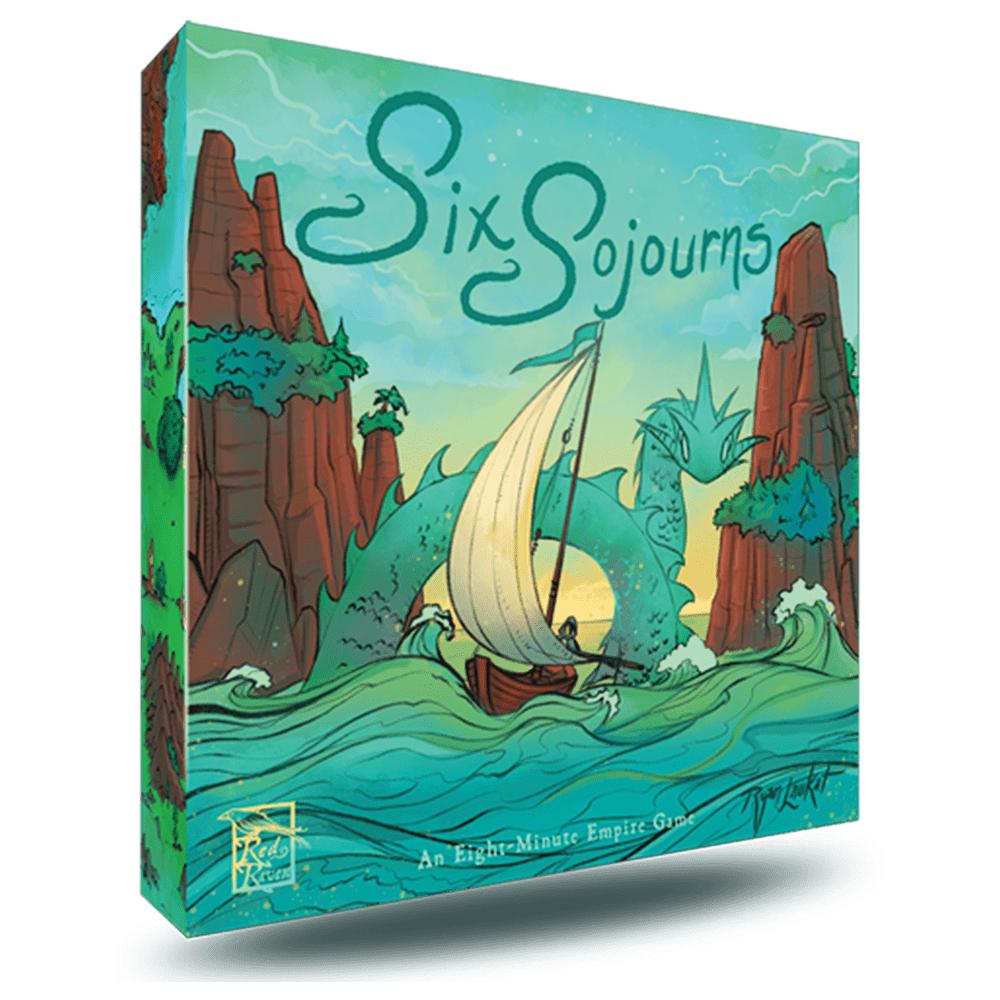
Ryan Laukat's artwork is one of the easiest things to appreciate about Six Sojourns. The game returns to Arzium, the setting shared by Above and Below, Near and Far, and several other Red Raven titles. There's a recognisable warmth to the illustrations, and the map has the sort of inviting quality that makes you want to investigate its little settlements.
The game itself, however, is much less concerned with the people living there. You're not meeting characters or discovering stories. The inhabitants are represented by pieces that contribute towards control, while the islands are primarily spaces with scoring implications. I don't consider that a failure of theme. An area-control game doesn't need paragraphs of narrative to justify its existence, and I would rather a design be comfortable with what it is than force storytelling into places where it doesn't belong.
Still, I suspect some players may approach Six Sojourns expecting something more adventurous because of the artwork and the setting. What they'll find is a fairly abstract strategy game wearing some lovely illustrations. The presentation also has a practical drawback. As more pieces accumulate on the map, particularly at higher player counts, determining who controls a space can become awkward. Houses count differently from people, and the smaller regions don't always leave much room to arrange everything clearly. It's a shame because the board is attractive, but a beautiful map is considerably less useful when you're trying to count what's underneath a pile of wooden pieces.
Final Verdict
What interests me most about Six Sojourns is the way it gives players two competing priorities. The map encourages you to spread out, while the card market rewards you for being selective. You cannot afford every card you want, and you certainly cannot accomplish everything on the board in nine turns. Working out what to abandon is as important as deciding what to pursue.
The absence of destructive combat is another appealing choice. It makes the territorial competition more accessible without removing the possibility of interference. I also appreciate the attention given to turn-order balance through the towers, which solve a problem that can be particularly irritating in short area-control games. My reservations are mostly about how those systems come together. Trade scoring can reduce the incentive to fight over territory, especially when the map offers plenty of room. The final turn threatens to be considerably slower than the rest of the game, and scoring everything at the end sounds more laborious than I'd prefer for a title aiming to finish within an hour. The modules are therefore a major part of the appeal. They offer ways to address some of those concerns, but I'd be careful about assuming that more content automatically produces a better experience. I suspect Six Sojourns will be at its best with a handful of well chosen additions rather than every available rule competing for attention.
I wouldn't approach it expecting the drama of a sprawling area-control game or the storytelling of Laukat's other Arzium titles. This is a card-drafting game first, in my opinion, with territorial expansion providing one important way to turn those purchases into points.
For players who enjoy that combination, there's a lot to be interested in. The short structure should make experimentation inviting, and the modular content gives the design room to develop without committing everyone to a longer game. I just hope nobody mistakes the welcoming artwork for a promise of an easy journey. Twelve coins disappear remarkably quickly when you have nine turns to spend them.
Zatu Review Summary
Score Zatu
78%