

By Peaches and Meeples
You move your Spartan across the battlefield, the opposition firing at you, but you crouch and hide in cover. Your team helps with some cover fire whilst your Spartan dashes and grabs the flag… this is it… will you get the flag back to your zone? Flag in hand, you make your move, but just as your finish line is in site, a lucky shot from the enemy Deadeye takes you down. Flag dropped; your Spartan respawns for another go. This is Halo… but I am not talking about the popular video game. No, this is Halo Flashpoint the board game – a tabletop miniatures games from Nottingham based company, Mantic.
So what is the game all about?
In short, Halo. If you know the video game, you probably know the story, and what the gameplay style is. But if you don’t know (or honestly even if you don’t like the game), the basic story is covered in the manual so you can still get the themes and stories surrounding this universe. Essentially humanity was forced to near extinction by an alien race, but from the ashes came super-soldiers (known as Spartans) who rose to help fight back. They were trained in war game combat arenas, basically a simulator designed to help mould them into the very best fighters possible. In tabletop terms however, this is a tabletop miniature skirmish game. Each player has a team of miniatures, and over a series of rounds, aim to complete whatever the objectives are. These objectives range from simply killing as many opponents as you can, to take and hold style objectives, to a classic capture the flag game.
By Peaches and Meeples
You move your Spartan across the battlefield, the opposition firing at you, but you crouch and hide in cover. Your team helps with some cover fire whilst your Spartan dashes and grabs the flag… this is it… will you get the flag back to your zone? Flag in hand, you make your move, but just as your finish line is in site, a lucky shot from the enemy Deadeye takes you down. Flag dropped; your Spartan respawns for another go. This is Halo… but I am not talking about the popular video game. No, this is Halo Flashpoint the board game – a tabletop miniatures games from Nottingham based company, Mantic.
So what is the game all about?
In short, Halo. If you know the video game, you probably know the story, and what the gameplay style is. But if you don’t know (or honestly even if you don’t like the game), the basic story is covered in the manual so you can still get the themes and stories surrounding this universe. Essentially humanity was forced to near extinction by an alien race, but from the ashes came super-soldiers (known as Spartans) who rose to help fight back. They were trained in war game combat arenas, basically a simulator designed to help mould them into the very best fighters possible. In tabletop terms however, this is a tabletop miniature skirmish game. Each player has a team of miniatures, and over a series of rounds, aim to complete whatever the objectives are. These objectives range from simply killing as many opponents as you can, to take and hold style objectives, to a classic capture the flag game.
Opening the contents of the supply crate…
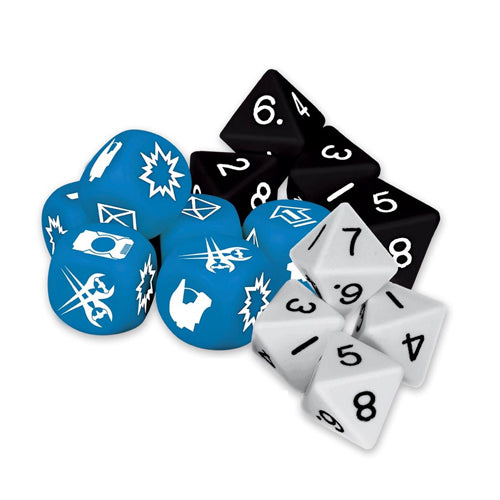
Inside the box you get everything you need. There are two teams of miniatures, four in blue and four in red. As with most miniatures games, you can later paint these if you wanted to (Mantic even do paint sets aimed at this game… someone give that member of staff a raise for that idea). You also get a set of D8 dice, command dice, card scenery, all the tokens you need, reference cards and a double sided playmat. The playmat particularly is a nice touch; one side is the basic battlefield for you to put scenery on and get playing, the other side acts as a training map – a reduced in size mat with all the core rules you need to learn placed around the outside. (Ok… again, Mantic you need to give whoever came up with this a pay rise! Honestly I cannot understate how great this addition is.)

No controllers in sight
Playing the game does not require any video game controllers in sight. This game is your classic tabletop miniatures skirmish game where dice rule!
When you first play this game, you really should try the training map first, even if you are a confident miniatures game fan. Why? Because frankly it is genius! All the core rules are scattered around the edge of the map, the map is reduced, you have only two miniatures each and it is a straight up fight to the last Spartan standing. This makes for a quick game but also one that helps you learn all the core rules. It did such a good job, when we played our first full game, about a week later, we barely had to check the rules, only the things we hadn’t come across in the training game.
The game play is simple, but don’t let this put you off if you are into games with complex and in-depth rules. The game plays over a series of rounds, defined by the scenario you are playing. In each round, you take it in turns to activate one of you miniatures and take either two short actions or one long action. These include things like advance (move), sprint, shoot, assault (hand to hand combat), stand up, crouch or take auxiliary actions. Each miniature has a set of stats (typical of this kind of game), which tell you how much they can move, how good they are at shooting or combat, and how tough they are. Moving is easy, you get two stats for movement; one (the smaller one) is your standard movement value, the second is your sprint value. When moving, you move through ‘cubes’ (this is great as it gives a 3d sense to your movement). The grid for these cubes is on the map, so no rules or measuring in sight. You can jump over scenery and climb up walls; all of this is covered by your movement with no overly complex rules how to undertake these actions. Shooting is also performed as simply as this. Your weapon has a range, identified using the same system as movement, but on the gun. If in range, you roll three D8, then depending on things such as how clear a shot you have, if the enemy or you are crouched, high ground or friendly fire, you add or remove dice. All you need is to roll the number (or higher) identified by that model’s ranged attack value. Roll an 8, and you will watch your opponent slump in fear as you get a bonus die. Roll another 8, and you get another… you see how this is going! Your opponent then rolls 3 D8 against their save value and get bonuses accordingly too. You take the successful saves number of dice from the successful shooting dice, and what is left takes down shields, then armour and if you still have dice left, actually wound the model. It sounds bonkers (a lot of miniature games like to have wound characteristics weapons) but this really makes for a clean and easy to follow experience, which is fair for everyone.
Hand to hand combat is great too. If you enter the cube with an opponent in, you automatically trigger hand to hand. The rules for this kind of fight work exactly the same as shooting. Again, this really helps with streamlining the rules and making the experience flow, with less hunting for rules. If you start an activation in the same cube as an opponent, you will do the assault action (which is a long action). Here you get bonuses or penalties for being injured or having a buddy bashing them at the same time.
If you are unfortunate enough to lose a fighter, don’t worry, there are respawn points on most scenarios so your fighter can come back on their next activation. This a great mechanic as it means even with a limited number of minis, you still feel like you have a proper skirmish force to play with. It also stops the opponent being able to suddenly become more overwhelming as they end up with way more minis than you and makes the end look inevitably bad for you.
Game play continues, whilst you are trying to meet objectives in time for the end game conditions, and you should be able to complete a game of this typically in 1 to 1.5 hours once you are confident with the gameplay. So that combined with the table sized battlefield, means you could quite possibly fit this in during the week if you wanted to.
Final thoughts
We play a lot of miniatures games; from games by the big name in the industry (and locals to Mantic in Nottingham), to other companies from further afield. Often, these types of games suffer with lots of rules to remember, complex interactions and rules you end up googling and reading reddit sites, or event the company FAQ’s just to clarify rules. Mantic however impress us. Their rules in Halo Flashpoint are clean and well written. Have something you want to clarify? The actual rule book has covered! In fact, the rules are so well written, it inspired us to want to look into other Mantic designed games (sorry bank account!). It was a real breath of fresh air. Our second game and we were barely looking up anything, just the rules we hadn’t covered in the training, but very quickly were reeling off what we needed to do. But don’t let the simplicity of some of the rules worry you if you are more experienced in these types of games, it does not detract from the fun. In fact, quite the opposite. Because everything is cleanly written and easy to follow, with rules that don’t be overly complex for the sake of it, it makes for fast and action-based game play and less like you are having to read the rules every five minutes. I would argue a lot of their competitors could learn from this. As mentioned, we play a lot of miniature games, and this has shot right up the list as one of our favourites, and to be clear… We don’t even like the video game! That is another thing to the credit of Mantic here. It is obvious they want the game to appeal to fans of the video game, after all why use the IP if you don’t right? But I would honestly say, if you don’t even like Halo the video game, it is still worth checking out this game if you are in to miniatures games. Never played a miniatures game before? Intrigued by them but always put off by the investment needed? Well, this has you covered too. The one box is everything you will ever need. Yes, you may WANT to buy future expansions, but you don’t have to and will still have a very fun game which as an entry point into this style of tabletop game, you couldn’t choose a better option.
Peaches and Meeples
We are proud guinea pig parents to two lovely fluffballs of joy and building an ever growing collection of tabletop games.
What do you think of the Halo Flashpoint board game? Let us know your thoughts by tagging us on Instagram!