

If there’s one type of game that’s guaranteed to grab my attention, it’s a nature-themed tile layer! In Habitats you take on the role of a park ranger tasked with creating an African nature reserve by placing tiles of animals, plants and assorted infrastructure. It certainly sounded like a perfect fit for my gaming preferences and, as I hoped when I picked it up, a distraction from the post-holiday blues after returning from an appropriately themed safari to Tanzania.
Serengeti-ing started
Habitats is played by up to five players over three rounds (or years as the game calls them) with a different number of turns each round depending on the player count. Each turn you’ll increase the size of your reserve by taking one tile from the market and placing it next to a tile already in your reserve. There are end-of-round goals to help you decide which tiles to pick and how best to place them. At the end of the game, you add up the points on your scoring tiles, combine these with your end-of-round points and the player with the highest score wins.
If there’s one type of game that’s guaranteed to grab my attention, it’s a nature-themed tile layer! In Habitats you take on the role of a park ranger tasked with creating an African nature reserve by placing tiles of animals, plants and assorted infrastructure. It certainly sounded like a perfect fit for my gaming preferences and, as I hoped when I picked it up, a distraction from the post-holiday blues after returning from an appropriately themed safari to Tanzania.
Serengeti-ing started
Habitats is played by up to five players over three rounds (or years as the game calls them) with a different number of turns each round depending on the player count. Each turn you’ll increase the size of your reserve by taking one tile from the market and placing it next to a tile already in your reserve. There are end-of-round goals to help you decide which tiles to pick and how best to place them. At the end of the game, you add up the points on your scoring tiles, combine these with your end-of-round points and the player with the highest score wins.
The initial setup involves selecting the end-of-round goals at random and giving the turn tracker to the starting player. Each player then chooses one of the five starting tiles along with its corresponding vehicle meeple (can we call it a veeple?).

Pick your ride.
You place your chosen starting tile to form the entrance to your reserve and then set up the market from which each player will pick a new tile on their turn. The market is formed by arranging a random selection of tiles face-up in a grid layout and placing each player’s veeple in the indicated starting position.

Two players ready for a safari.
Safari njema!
Safari njema is Swahili for “good journey”, and there is something of a journey involved in playing Habitats. On your turn, you must select a tile from the market and place it in your reserve. Selecting a tile involves a fun minigame in which you drive your veeple to the tile you want to collect. You can’t just drive directly to whichever tile you find most interesting, however, that would be too easy! Each turn you can drive one space forwards or to the left or right (you’re only allowed to reverse if all your other routes are blocked). If the tile you really want is at the opposite side of the grid you need to plot your path carefully – do you go by the most direct route possible to secure the tile you really want, or do you have time for a quick detour to pick up another tile before an opponent beats you to it? This makes the tile selection mechanism both a fun puzzle and, if you use a lot of imagination, vaguely evocative of bouncing across the Serengeti in the back of a dusty Landcruiser, eyes peeled for the next exciting animal sighting.
Competition for tiles can be as fierce as some of the animals you’ll be collecting. Although the size of the market scales according to the number of players, you can still find your veeple blocked by others, much like in the real-world scrum of vehicles jostling for the best view of a prowling lion in the Ngorongoro crater. Unlike in the real-world, however, if you find your veeple is hemmed in, you’re permitted to jump, Dukes of Hazzard-style, over another player to reach the next tile. It’s not exactly thematic, but it is fun!

More players means a bigger market, but it still gets crowded.
Once you’ve finally collected a tile from the market, you fill in the space behind your veeple with a new tile selected at random from the bag (hoping that it’s not something exciting enough that you’ll immediately want to make a U-turn).
You then have to contend with the main puzzle of where to place your chosen tile in your reserve! Each tile has one of four different background colours indicating the type of habitat it belongs to (grassland, water, forest or desert). Most tiles also have either a plant, animal or park amenity (a gate, campsite or watchtower) along with a points value which you score at the end of the game according to various criteria. Plant tiles have no special criteria; they score simply by being part of your reserve. Animal tiles score only if you place them adjacent to tiles which meet their habitat requirements. The criteria for scoring amenities are a little more complex but are worth getting to grips with as they can provide plenty of points at the end of the game. I do find it easy to overlook the amenities however, and I often find myself ignoring them in favour of the animals – who wants to collect a boring campsite when you can pick up a pangolin instead?

You can use the handy score markers to remind you which tiles meet their scoring criteria.
Kudus for the presentation
Habitats is an appealing game to look at, full of bold, bright colours throughout. I adore the box artwork with its stylised, imperious lion – it’s just a pity that this art style doesn’t carry over to the tiles that you spend most of your time looking at. Here the artwork is more serviceable than beautiful and the cartoony style results in a few animals which look a little derpy, albeit in an endearing sort of way.

The baboon is a personal favourite.
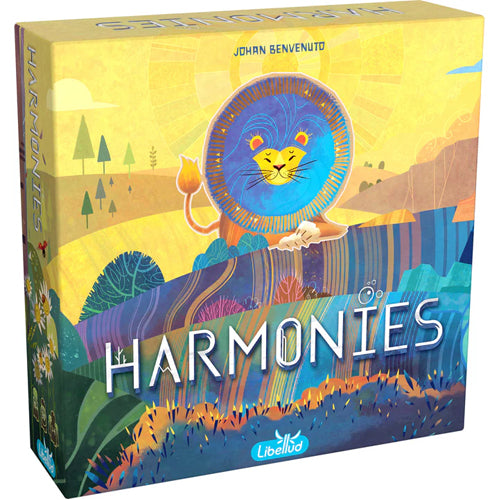
Perhaps I’ve been spoiled recently with the beautiful illustrations of games like Wingspan and Harmonies, but Habitats’ artwork just doesn’t do quite enough for me.
The important thing is that, with their distinctive background colours and clear icons, it’s easy to see which type of habitat a tile belongs to and the criteria it must meet in order to score at the end of the game. This clarity carries through to the four-page rules booklet with its helpful diagrams and scoring examples making Habitats a breeze to play (even if the decisions you have to make are frequently tricky!).
Habitats’ components are good quality with thick, sturdy card for the tiles and brightly coloured, wooden player markers. I’m a fan of the erasable scoreboard (as opposed to a pad of single-use, disposable scoresheets) and the inclusion of a dry-erase marker pen is a nice touch. The fabric bag provided to hold the tiles is also lovely with its vibrant colour scheme. It’s a shame then that the bag is far too small to hold all the tiles and allow room to mix them properly. While not a major issue, this feels like a problem which should have been spotted before Habitats went into production.

It’s a lovely bag, it just needs to be twice the size!
I gnu I’d like it
It’s fair to say that I was predisposed to liking Habitats and I’ve thoroughly enjoyed my plays of it so far. I was a little concerned that it would be too similar to some of the other nature-themed tile-laying games in my collection. However, the tile selection minigame does more than enough to make Habitats stand out from other favourites like Harmonies and Cascadia.
The simple, concise rules make Habitats a smooth, easy game to play, yet there’s still plenty of crunchiness in the competition for tiles and decisions on where to place them to keep things interesting. It plays quickly and doesn’t outstay its welcome – the box’s estimate of 40 minutes
is fairly accurate. With the varied, randomised round goals and large choice of tiles, there’s lots of scope for replaying without the game feeling too samey. And Habitats is the type of game that you’ll actually want to play again!
While Habitats isn’t going to replace Harmonies at the top of my most-played games list, it is different and enjoyable enough to find a natural home in my collection.
Zatu Review Summary
Zatu Score
85%