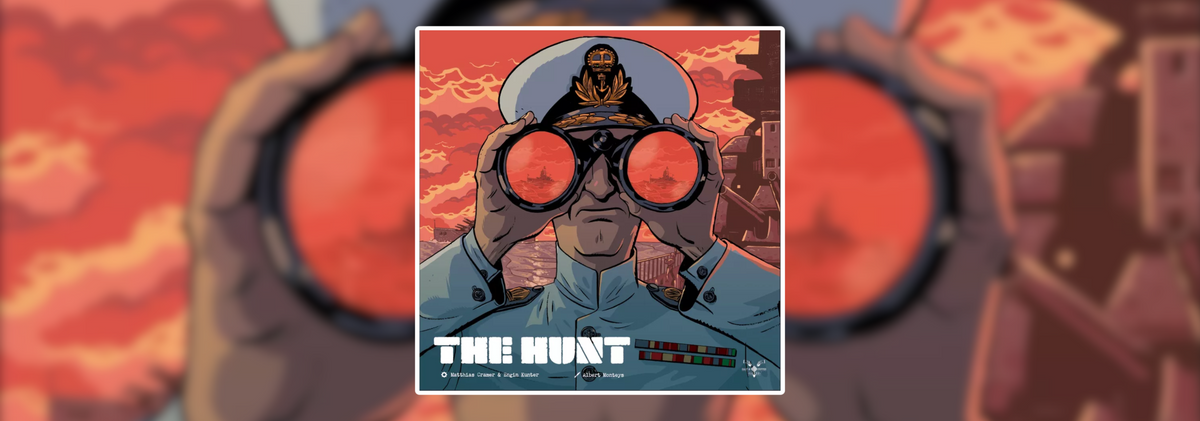
If you fancy yourself as something of a naval tactician, or someone who enjoys a game of intra-Atlantic cat and mouse, then The Hunt might just be the game for you!
Introduction
The Hunt is a neat, asymmetric 2-player game that simulates some of the events of early Word War Two. Borrowing from the publisher because I’m not a military historian…
In September 1939, the commander of the Admiral Graf Spee receives the order to sink as many British freight ships as possible in the South Atlantic. The objective is to intercept the ships crossing the Atlantic and prevent supplies from reaching the UK and other destinations.
The plan seems to work in the first months. Within a few weeks, the Admiral Graf Spee sinks nine freight ships and sends almost 50,000 gross register tons to the seabed.
In The Hunt, one player will take on the role of the British fleet, trying to find and destroy the Graf Spee battleship, while the other tries to navigate the waters and take out the freight ships that are crossing the ocean.
Radars on old boy
This is a good example of “lots of game in a fairly small box” which you love to see. There’s an incredible amount of gameplay for what is a pretty compact board, 18 cards per player and a handful of tokens/markers.
Setup is pretty swift, with predetermined starting spaces for the British fleet, while the German Altmark ship can be placed anywhere. The Admiral Graf Spee token isn’t physically placed on the board but you must mark its starting tile on a bit of paper or similar. The nine freight ship tokens are placed in the provided bag, two are drawn at random and placed on their appropriate starting port spaces. You’ll need two different starting ports so redraw if you grab a duplicate.
Finally, place the two wooden tokens on their appropriate spaces on the German side of the board and each player shuffles their deck and draws five cards.
Let’s hunt some… sneaky ships.
Let battle commence!

Well… battle maybe comes later. Maybe. The German player always goes first and then, predictably, turns alternate until someone wins. Before we get into the substance of how you play, I’ll cover the different win conditions here as you’ll get an idea of how you have a couple of things to balance.
- The Germans win if they sink five freight ships
- The British win if they manage to get five freight ships to their destination ports (which the game itself suggests is unlikely)
- Either side could win if the British successful hunt and reveal the Admiral Graf Spee as this triggers a battle which will determine the victor. Here the rulebook will also tell you that if this happens, the Brits have stronger cards meaning a victory for them is more likely
There is also a specific card combo for the final duel in the battle that guarantees a British victory, but we’ll come back to that later.
Anchors away!
Turns are easily structured:
- Move freight ships (British player only)
- Play a card
- Draw up to your hand limit (always 5 for the Brits, 3 or 5 for the Germans depending on the hidden battleship location)
I’ll cover each of these in order now
Move freight ships (British only)
This is a simple one, as you move each freight ship one space towards their destination port, and if you’re able to enter that port from one of the arrow-marked spaces, you can remove it and consider it all a thoroughly good job well done! If you’ve got fewer than two freight ships on the board, draw another pop the old gal next to her port of departure!
Play a card
This is absolutely the substance of the game and will be where you’ll be planning and initiating your skilful strategy. Or in my case, tactical panic!
Cards are multi-use and can mostly be played for their written text effect (referred to throughout as an “event”) or for their numerical action-point value which you can then spend as you see fit. There are a few exceptions/conditions around this which I’ll briefly highlight.
Some cards are mandatory events, which means you must use their written text unless they are being used in the battle phase (which we’ll discuss below). Equally, some are specifically battle events which means their written text only applies during a battle and otherwise must be used for their action point value.
Actions points (hereafter ‘AP’) can broadly be spent for the same things, though there are a couple of player-specific elements thrown in the mix.
For movement you can spend up to 4 AP to move up to 3 spaces and move each token once per turn – this includes the ‘hidden’ Admiral Graf Spee, although this is allowed to move-search-move as an exception. What’s interesting about movement in general – particularly for the German player, is that you can spend the AP but move a different number of spaces. For example, I could choose to spend 4AP to move the hidden sub up to three spaces. But maybe I only move one or two. It creates an intrinsically wider net for the British player to focus on, but without ever knowing the full extent of it. A small semantic rule, but a really important one!
Searching is a little different depending on which side you’re on. The Germans reveal the Graf Spee’s location by placing the token on the board, spend 2 AP, roll the die and successfully sink a freight ship with a 5+ result. You have a plane area on your side of the board (air support I suppose?) that you can switch from active to damaged to add 2 to that result – this is definitely helpful.
The British only spend 1 AP to search a space they have a navy ship and again are successful with a 5+. They are also allowed to spend an extra 1 AP and play a card from their hand for the “intelligence” effect at the bottom. This is unique to the Brits and can often be situationally beneficial. Intelligence comes in the form of a binoculars icon (allowing you to add 1 to your roll result for each icon) or a hint icon which means the German player must place one of the hint tokens on or adjacent to the Graf Spee’s current location. You can play multiple cards at the same time providing you have the AP for them, but you must of course declare these before you roll – no backsies in love and war.
The other AP elements are particular to the side you’re on
- The Germans may spend 1 AP to repair the plane where they must then roll the die and compare the result to the number of German cards that have been removed from the game (due to their event effect). You must roll higher otherwise the plane is permanently destroyed and you’re out of air support on your strikes. This typically feels risk-free in the early game but you’ll start to think twice about using powerful cards for their effects which may be removed later on
- The Germans also have a fuel reserve which means they can bank up to a ma of 2 AP to spend on later turns. This is definitely helpful and can help you out of a tight spot if needed
- The British have one additional option which is to spend 2 AP to move one of their reserve ships closer to being deployed. They only start with one navy ship at sea and the other two have to be moved towards readiness by spending AP. Obviously you want to have more ships out there searching the high seas, but you don’t want to let the German player run roughshod over the freight in the meantime so rushing these out might feel urgent but isn’t always the best play
Draw up cards
Pretty simple end of turn step here – if you’re the British player you draw until you have 5 cards in hand. If you’re the German player, your default is draw up to 3. However… if the Graf Spee is adjacent to the Altmark supply ship you may choose to draw up to 5 cards instead. Obviously this tells your opponent something about where you are, and is made riskier if you’ve recently had to place a hint token as well so picking and choosing when you do this is key.
Let battle commence!

We’ll assume you’ve not won or lost on the freight ship condition, and instead the British have successfully uncovered the location of the Graf Spee and it’s now Battle O’Clock. Things are about to get jolly serious now!
Each player draws up to 5 cards in hand as the battle takes place over five duels – we wouldn’t want all that effort just for a draw would we?
Each person picks a card from their hand and reveals it simultaneously and compares the AP value. The British forces tokens have either a 0, +1/2 or +1 on them so depending on exactly which ship makes the discovery there may be an additional bonus to add to the score. If you’ve revealed a card with a Battle Event on it, you resolve that and also use the AP score – again, quite powerful.
Compare the (modified) scores and the side with the lower value takes a hit marker and places it on their side of the track. If it’s a tie, nobody takes a hit. You resolve all 5 duels and whoever has the most damage loses. If it’s a tie after all that, the British win. Unless…
Secret “surprise” twist
There’s a bit of a ‘last stand’ approach in each player’s deck, relating to the Admiral Graf Spee’s temporary retreat into the neutral port of Montevideo in December 1939. If, during the final duel only the German player uses their “Montevideo” card they automatically win…
Unless…
The British player also plays their “Scuttling in Montevideo” card in which case they win.
Unless…
No I’m joking, that’s it. Those cards can be played earlier in the duels but their effects only kick in on the fifth and final one, otherwise it’s just their AP value you need to look at.
Final thoughts
I’m a bit hit-and-miss with hidden movement games – mostly I think because I rarely have the logical mind needed to track down the hidden player. When playing The Hunt I prefer the Germans just because it better suits my style of playing these kinds of games.
As I noted earlier, I am by no means even a casual military history buff, but having played this with a friend who is a lot more knowledgeable than me, I can confirm they were delighted with some of the detail within the cards, so I think that’s a tick in the positive column.
There are player aid cards that are specific to each side so you don’t have to constantly be remembering how to spend AP or what makes you different from your opponents – it’s all in front of you and it’s easily referenced. Setup is easy, turns aren’t complicated in themselves, though depending on how much you want to umm and ahh over things, you might end up caught between the devil and the deep blue Atlantic in how you actually execute your turns.
On the downside there is a certain… inevitability to how games might well end. Chances are with an 18-card deck, you’re both going to end up with your respective Montevideo cards in hand at some point. And you aren’t going to want to play them for anything. Which means unless your win on freight, you’re probably heading for a battle… Unless the Germans take 3 of the first 4 rounds (which isn’t overly likely given the relative strengths as the rulebook points out), well… those 2 cards are going to play a big part in the outcome. It may be that you hold onto it and bluff your opponent and lay yours down in duel 4. It might work, but it’s also worth noting that there are cards that allow you to see your opponent’s hand and if you’re at the mercy of one of those in a battle I think you’ll struggle to win.
I’m not at all saying it’s always “go to a battle, lose on the last card” kinda game, but it’s definitely possible, and once you’re in a battle the odds are stacked in favour of the chaps at the Royal Navy.
I enjoyed it a lot more than a) I expected and b) I usually enjoy hidden movement games. It’s sleek and thematically well done so it definitely scores points for that. It might not win you over if you aren’t wild about the genre but there’s a reasonable chance you haven’t made it this far down the review in that case either!