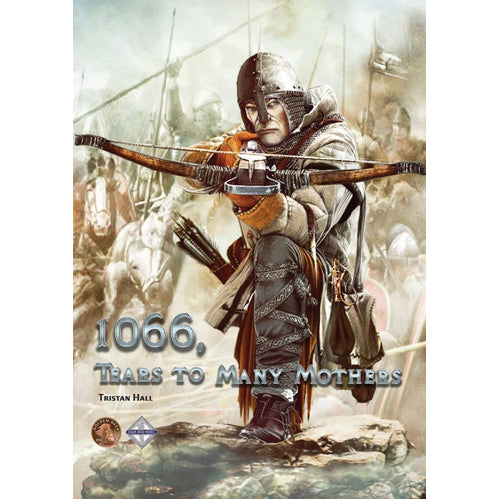
In 1066 the fate of a nation was changed forever. Warring Saxon Kings and Lords were forced to come together to battle an invading horde of Normans, settlers from the north, like they had been, stretching out to expand their dominion to an island just a short distance away.
Since that fateful moment, the land of the Angles (England if you will) has grown, changed and yet that year is the date all know as a defining moment in English history, the day Harald Harada was slain, immortalised in the Bayeux Tapestry.
Now, you can recreate it in a two-player card game from the publishers of Gloom of Kilforth. 1066, Tears to Many Mothers (named after a prophecy made about Halley’s Comet) attempts to accurately but simply recreate the events of, and that led up to, the Battle of Hastings. Full of real historical figures and events, this game is not only fun to play, but also brings with it the suggestion that you might well learn something about real history.
In 1066 the fate of a nation was changed forever. Warring Saxon Kings and Lords were forced to come together to battle an invading horde of Normans, settlers from the north, like they had been, stretching out to expand their dominion to an island just a short distance away.
Since that fateful moment, the land of the Angles (England if you will) has grown, changed and yet that year is the date all know as a defining moment in English history, the day Harald Harada was slain, immortalised in the Bayeux Tapestry.
Now, you can recreate it in a two-player card game from the publishers of Gloom of Kilforth. 1066, Tears to Many Mothers (named after a prophecy made about Halley’s Comet) attempts to accurately but simply recreate the events of, and that led up to, the Battle of Hastings. Full of real historical figures and events, this game is not only fun to play, but also brings with it the suggestion that you might well learn something about real history.
Components
1066, Tears to Many Mothers includes two unique decks (with a few correction cards for mistakes that were noticed before shipping – though no actual guidance on what they are) as well as a series of cardboard tokens that are used as markers during the game.
Finally, there is a simple rulebook that gives players all of the information they need to play the game (though no strategy, that you have to work out yourself!).
 1066 Tears to Many Mothers – Artwork and Cards (Credit: Hall or Nothing Productions)
Gameplay
With play taking place in a series of back and forth rounds, 1066, Tears to Many Mothers plays like many other card games. Each turn, players have the opportunity to attempt to complete tasks, to play characters, units, attachments and events. Resources are limited and must be carefully managed if a player wishes to defend their three wedges and complete the tasks required to win the game. Units have combat and social strengths as well as health and abilities that they can use in each round. None of this is unique or strange to anyone who has played any CCG or LCG. What is perhaps more unique are the limits of units, players have three wedges to deploy to, each with only three slots for units and one of these is always taken up with your leader – either Harald Harada or William of Normandy – and you must always protect them as their destruction means an instant loss. Players are competing to complete a series of tasks that track the lead up to the Battle of Hastings, each requiring the player to meet certain requirements such as combat or social strength and, though the requirements are very similar, each player has particular strengths and weaknesses – the Normans are better at the early social conflicts, whilst the Saxons are better at the later military combats. This means, that whilst each player needs to amass and do similar things, the Normans will move through early tasks far quicker, getting them closer to the Battle of Hastings (where they can destroy their opponent’s wedges for victory), whilst the Saxons will struggle to get there but will dominate if they do. The whole process leads one to wonder if Harald Harada had been a ‘people person’ rather than a fighter, we’d be less French and more German?Final Thoughts on 1066, Tears to Many Mothers
Overall, 1066, Tears to Many Mothers is an interesting take on a card game, especially with its historical focus. Sadly, the asymmetry of the two sides, but not of the tasks required to get to the fight, means that the Normans have an advantage because they can get to the real way to win the game far faster than the Saxons can. Whilst historically accurate, this isn’t necessarily that fun.
In 1066 the fate of a nation was changed forever. Warring Saxon Kings and Lords were forced to come together to battle an invading horde of Normans, settlers from the north, like they had been, stretching out to expand their dominion to an island just a short distance away.
Since that fateful moment, the land of the Angles (England if you will) has grown, changed and yet that year is the date all know as a defining moment in English history, the day Harald Harada was slain, immortalised in the Bayeux Tapestry.
Now, you can recreate it in a two-player card game from the publishers of Gloom of Kilforth. 1066, Tears to Many Mothers (named after a prophecy made about Halley’s Comet) attempts to accurately but simply recreate the events of, and that led up to, the Battle of Hastings. Full of real historical figures and events, this game is not only fun to play, but also brings with it the suggestion that you might well learn something about real history.
Components
1066, Tears to Many Mothers includes two unique decks (with a few correction cards for mistakes that were noticed before shipping – though no actual guidance on what they are) as well as a series of cardboard tokens that are used as markers during the game.
Finally, there is a simple rulebook that gives players all of the information they need to play the game (though no strategy, that you have to work out yourself!).
1066 Tears to Many Mothers – Artwork and Cards (Credit: Hall or Nothing Productions)
Gameplay
With play taking place in a series of back and forth rounds, 1066, Tears to Many Mothers plays like many other card games. Each turn, players have the opportunity to attempt to complete tasks, to play characters, units, attachments and events. Resources are limited and must be carefully managed if a player wishes to defend their three wedges and complete the tasks required to win the game. Units have combat and social strengths as well as health and abilities that they can use in each round. None of this is unique or strange to anyone who has played any CCG or LCG. What is perhaps more unique are the limits of units, players have three wedges to deploy to, each with only three slots for units and one of these is always taken up with your leader – either Harald Harada or William of Normandy – and you must always protect them as their destruction means an instant loss. Players are competing to complete a series of tasks that track the lead up to the Battle of Hastings, each requiring the player to meet certain requirements such as combat or social strength and, though the requirements are very similar, each player has particular strengths and weaknesses – the Normans are better at the early social conflicts, whilst the Saxons are better at the later military combats. This means, that whilst each player needs to amass and do similar things, the Normans will move through early tasks far quicker, getting them closer to the Battle of Hastings (where they can destroy their opponent’s wedges for victory), whilst the Saxons will struggle to get there but will dominate if they do. The whole process leads one to wonder if Harald Harada had been a ‘people person’ rather than a fighter, we’d be less French and more German?Final Thoughts on 1066, Tears to Many Mothers
Overall, 1066, Tears to Many Mothers is an interesting take on a card game, especially with its historical focus. Sadly, the asymmetry of the two sides, but not of the tasks required to get to the fight, means that the Normans have an advantage because they can get to the real way to win the game far faster than the Saxons can. Whilst historically accurate, this isn’t necessarily that fun.
Zatu Review Summary
Zatu Score
70%