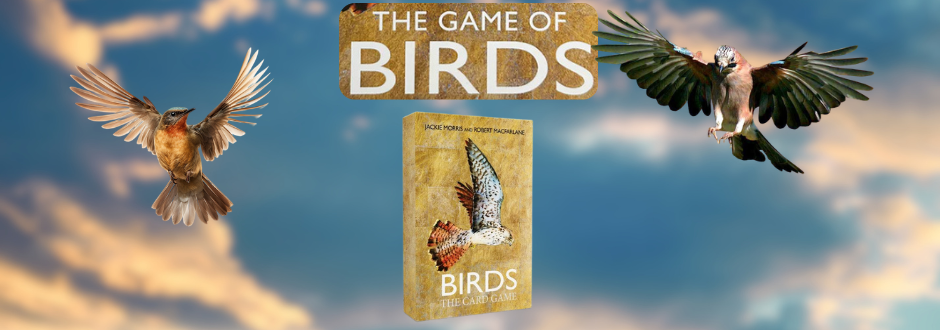
Cards featuring beautifully illustrated birds? Laid out in a grid pattern? With dice? Surely, I must be talking about the fan favourite Wingspan? If you thought that, you'd be sadly mistaken—as I've been playing the new Kosmos game The Game of Birds (which, ironically, is what I call Wingspan when trying to explain it to someone). So, let's do a fly-by and see if it can knock the classic Wingspan off its perch.
How to Play
The Game of Birds is a 2–4 player card game that takes around 20 minutes to play. Taking on the role of conservationists, players must 'rescue' birds and place them into a sanctuary tableau in front of them, while avoiding Threat cards that score negative points. To build the best sanctuary, players collect birds and arrange them into the seven 'Bird Wonders': Nest, Flight, Feather, Egg, Beak, Migration and Song. Players score more points for completing sets of three matching birds within each Wonder, with rarer birds being worth even more.
During each turn, birds are laid out on the board in a grid pattern, with some cards face down depending on a randomly selected configuration drawn at the beginning of the round. The first player rolls six dice, after which the two black dice are removed and placed in designated spaces on the board. These dice negatively affect the round in one way or another—perhaps preventing you from playing cards from a certain Wonder, or forcing you to discard a card. The remaining four dice provide positive effects that players can choose from, such as playing an additional bird card or looking at a face-down bird.
On the 3x3 grid, each row, column and diagonal corresponds to one of the seven Bird Wonders. On your turn, you discard a card from your hand matching the Wonder linked to the row or column you want to collect from, taking all three cards from that line. Any Threat cards taken are placed into your personal tableau, blocking spaces where point-scoring birds could otherwise go, while also costing points at the end of the game. You may then play up to two bird cards from your hand into your tableau (organised by Wonder, with a maximum of three birds in each), and you're free to replace birds you've already played if you wish. The grid is then replenished for the next player. At the end of the round, any remaining cards are discarded and a completely new grid is set up using a fresh configuration.
Scoring
At the end of a set number of rounds (determined by the player count), players score their conservation efforts in several ways. Each bird card has a point value based on how endangered the species is, with additional points awarded for collecting multiple copies of the same bird. Players also receive a Conservation Medal for every complete row in their sanctuary (having at least one bird in every Wonder), lose points for each Threat card they have collected, and add any bonus points gained from the positive dice. The player with the highest score wins.
How does it look and feel?
The artwork on these cards is genuinely stunning. The illustrations are beautifully detailed and are easily one of the game's biggest strengths. The cards are also minimalist and uncluttered, making the game feel approachable and easy to learn—you aren't trying to decipher what eight different icons all mean. That simplicity really allows the artwork to shine.
Design-wise, the overall presentation is quite formal, especially for a game aimed at ages 8+. It feels like it's come straight from a museum exhibition or a birdwatching guide—which isn't meant as a criticism—but it does make the game feel rather 'beige', disguising what is actually a very accessible, family-friendly experience. I can't help but think some people might overlook it simply because, at first glance, it gives off the sort of vibes of something your grandparents might pull out during a rainy caravan holiday in Skegness.
How does it play?
The Game of Birds offers some enjoyable, light strategy. It's exactly the sort of game you could bring out at a family gathering, or play with someone who doesn't normally enjoy board games but happens to love birds. It's quick to set up, easy to learn, and resetting between games is little more than shuffling the cards and laying out the board again.
In some ways, though, the rulebook overcomplicates things by over-explaining certain rules while under-explaining others. For example, during one game we managed to run out of cards in our hands after repeatedly rolling the "Discard a card" effect on the black dice, combined with some slightly questionable decision-making. With no cards left, we couldn't discard anything to collect more cards, leaving us effectively stuck. We couldn't find any reference to this situation in the rulebook. Some small additions would really benefit the game, such as a video tutorial or even a simple player aid for each person.
Gameplay-wise, there aren't many real sticking points, just a couple of things to get used to. Firstly, as with many games of this type, your success is heavily dependent on which cards appear. There are 140 bird cards, alongside 28 Threat cards shuffled into the deck. Depending on the player count, you'll only see a little over 100 cards during a game. That means if you're waiting for several specific birds to appear, it can have a significant impact on both your strategy and your final score. Because all unclaimed cards are discarded at the end of each round, you may only have a single opportunity to grab that Swan you've been waiting for (a phrase that feels slightly wrong given the game's conservationist theme!).
That randomness can make long-term planning difficult, but once you accept that, it also helps keep the game feeling fresh, fast-paced and pleasantly light.
Would you recommend it?
For me, The Game of Birds feels like Wingspan Lite—a game I could teach in five minutes rather than twenty. It's something I'd happily take to the pub, where people would admire its beautiful artwork rather than stare at the board wondering where to begin.
Hopefully, as the game becomes more widely played and reviewed, we'll see more rules clarifications and tutorial videos appear to help where the rulebook currently falls short.
Overall, yes—I would recommend it. This is an accessible, attractive game that's perfect for people who enjoy birds and lighter strategy games. I'll also be very interested to see how it compares with Wingspan Pocket, due to be released later this year, which appears to be aiming for a very similar niche.