A few weeks ago, I received a copy of Heroes of Timeline to review. As it is a 2 player game, I decided to recruit none other than my partner as she is as much an avid gamer as I am. Maybe I shouldn’t have? Long story short: she kicked my xxx each time we played this game… but nonetheless, I’m the one writing the review now. So, let me share with you what we discovered during our journey in the Timeline...
Graphic design and illustrations
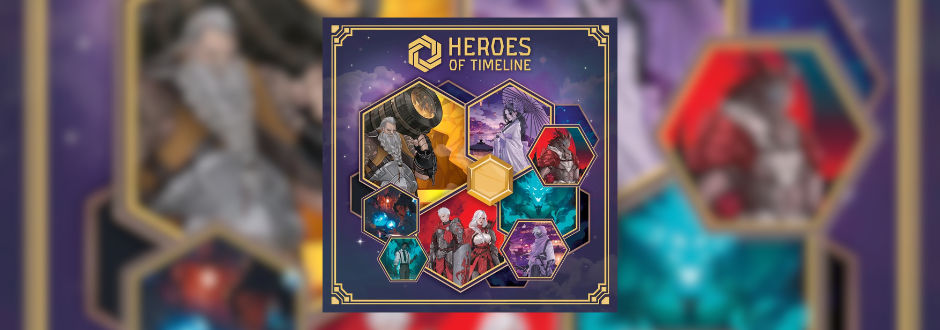
As soon as I saw the box with its shades of purple, its golden lines and its fantasy-like heroes set in hexagons, it attracted my attention and my level of excitement skyrocketed. I was eager to open it and see what was inside.
I must say there was no disappointment! The quality of the artwork and the overall graphic design is really good. The colour theme revolves around the one of the box, giving a welcomed, otherworldly atmosphere. Aren’t we in the Timeline, after all?

Each of the four factions one can play has its own colour, with the back of their team and hero cards showing a different illustration, one related to the time they are coming from. The golden embossing also adds a classy touch to the cards.
Talking about factions, the Dragon hunters (red/bordeaux) war heroes come from a time where humanity struggles against the Dark Flame dragons. The guards of Witgart (yellow/brown) are ancestors of a mountain tribe that witnessed the celestial fall. The anonymous Hidden Temple ninjas (purple), are none less than protecting off the grand Gaang Port of the East while the Institute (blue/green) comes from a point of the timeline that is rich in anomalies and paradoxes.
Each character is detailed with a beautiful illustration and of a different style. They could easily be from an anime or a comic book.

The hexagonal bases of the tokens and the walls, as for them, are both made of a purple plastic that combines very well with the rest of the game while the game board itself is made of a strong rigid cardboard with different blue tones.
Last but not least, the Core rules booklet presenting the game and its rules is also respecting the same colour pattern.
Board, tokens and other paraphernalia
In boardgames, the board itself is often the centre piece and this one is quite impressive, I must say. The way it folds is ingenious and really well thought out, making it easy to use, though I would have appreciated some more conspicuous colours for the delimitation of the inner zone (the one where you can’t put walls at the beginning of the game) making therefore easier the placement of the walls.
The tokens themselves are in two parts, the hero portrait, on a solid cardboard delimited by a frame in the colour of the team, and the purple plastic base. The latter one is made of two plug in pieces that you will need to assemble and I strongly recommend that you glue them together as they are meant to hold the armour tokens. If you don’t, they will quickly start to come apart, stretched by the armour tokens that are of the same thick cardboard as the portraits and the board. They are quite small but do not worry as there are enough of them to replace any you might lose.
The other components are the factions and heroes cards, made of thin cardboard easily readable and very convenient to use, the eighteen plastic walls, well made and stable when in use on the board and the 42-pages rulebook in an A5 format that fits wonderfully in the hand and is not too heavy.

Rules: the theory of the game
The Core rules booklet is well structured. The rules are clear, progressive and not overcomplicated. The font is big enough to be read easily and many illustrations and examples help to understand what to do and when to do it. We didn’t have any problem setting the game correctly.
Each turn develops around a short sequence: Move-Turn-Attack. Move your hero, face the direction you want and launch your attack, from afar or a melee one. Easy, no?
Add the fact that not only does each team have a special skill that can change some outcomes during the game itself, but each hero also has a special ability, and you can already get a multitude of possible combinations.
Now, if at any point during the game your team has at least two less members than your opponent, some of your heroes will be allowed to move up to one tile and turn or shoot in the direction they face, making it a second opportunity to hinder your opponent’s plans. This rule, called the Reflex Move, is made to prevent a real imbalance during a turn.
The game itself is played in five turns. To win one of them, you can either occupy the key tile (the one in gold in the centre of the board), or occupy more uncontested sectors than your opponents . But if you lose a turn, you will suffer a Bord’s Punishment: basically, a disadvantage that can go from a limitation on your movement to the downgrading of all your armours. That’s tough!
To win the game you can either totally eliminate your opponent Heroes or win more turns than them.
In theory, nothing seemed difficult and to make sure we understood correctly, we even watched the official 25 minutes video on Youtube, showing a complete game with the rules’ application, thanks to the QR code provided in the rules booklet.

The first game and beyond!
Well, the first game was very short. She was playing the Hidden Temple faction and I was playing the Dragon Hunters. I went directly for the key tile, the one that makes sure you win the turn and of course, couldn’t hold the position for long before she sent her ninjas to backstab me.
Fighting was brutal and deadly as melee attacks can eliminate a hero even if they wear a Regular armour, whereas a Superior armour is totally destroyed.
In two turns, my three heroes were dead, leaving us with a few questions about the application of certain rules: do you have to face your enemy for a melee attack? Can you do a range attack even when you are on adjacent hexagons? The answers were not in the rulebook nor in the video.
That’s when we decided to go back to the source: from the official website, I sent an email to the game creator (Alik). Within 24 hours, I received a clear and nice answer: ‘Yes, and yes, you can! Have fun!’ And of course, having these answers allowed us to add a lot to the tactics we used afterwards.

We played alternatively with each team and tried different combinations but like the motto of the games says: it’s easy to understand and hard to master.
During our games, we had several times the impression that it was easier to win with a larger team as there are more options, especially when going for the strategy of controlling sectors. But we remain beginners and more advanced players would certainly be able to overcome this parameter as there must be some good combinations we didn’t think about.
I also felt very frustrated because of the Bord’s punishment rule. Not only was I often losing turns but I had to endure limitations on my team, making it even more difficult to win the following ones and almost impossible to win the game. At some point we just stopped using this specific rule.
However, my partner and I both particularly liked to play the Guards of Witgat as it is a four Heroes team with a strong team ability to quickly add walls on the board, therefore limiting the opponents moves. The Institute was a bit difficult to use correctly because of the different combinations it provides while the Dragon hunters and the Hidden temple offered us some good moments with fun surprises.
Overall
It’s a great game if you like to spend some time developing your tactics and learning more about how to play each faction. Not unlike chess actually. The rules are easy to learn, but it is indeed very difficult to master and we never managed to go beyond the third round out of the five possible. Maybe Bord should have sided with the loser of a turn to help them instead of the winner?
Also, we wished we had more lore about all these four factions (even if a bit more is revealed in the video) and somehow, it is even a pity that none other exists.
But in the end, we had some good time playing the game and we didn’t see the time pass. I can only suppose that’s one of the effects of being in the Timeline.

Overall 78/100
Artwork 5/5
Complexity 4/5
Replayability 5/5
Player interaction 4/5
Component quality 4/5
—----------------------------------------------------------------------------------
Things I liked
- The artwork and the overall theme of the game
- The quality of the components: they are made to last
- The video to explain the game is a great add-on to the core rules booklet
- The tactical possibilities are huge, almost like in chess
Things I disliked
- Bord’s punishment: it becomes even more difficult for the player who lost the previous turn to win the next one
- The tokens’ base that need to be glued to make sure the armour tokens are kept in place
- There can be a slight imbalance when one player uses a smaller team despite the specific rules to counter this (Reflex move).
- Some situational rules are missing in the rulebook
- Like said in the video and in the rulebook: it really takes time to master the game and it feels sometimes frustrating