Its probably fair to say that when you play a lot of games, you might play a few of the same two or three for a while, they stay downstairs and the next unboxing arrives and they go back on the shelves for a while. We might then be heard saying, fancy a game of, oh I don’t know, Ark Nova or Recall for example. I’m not sure the words “fancy playing a game about the Spanish Civil War” would ever appear in the same sentence.
Until now. Espana 1936, from Devir games was reprinted a couple of years ago and I was fortunate enough to get a review copy from the folks at Zatu. Fortunate because we don’t have anything like this in our collection so it was a great opportunity to play and review something I wouldn’t ordinarily look at.
Originally released waaay back in 2007 in Spanish and designed by Antonio Catalan, the first English edition was 2008, to a fair amount of acclaim and was well received, mostly by war gamers - I don’t get the sense it ever appealed to a more “mainstream” audience. Maybe the theme, aesthetics or the game time was a consideration.
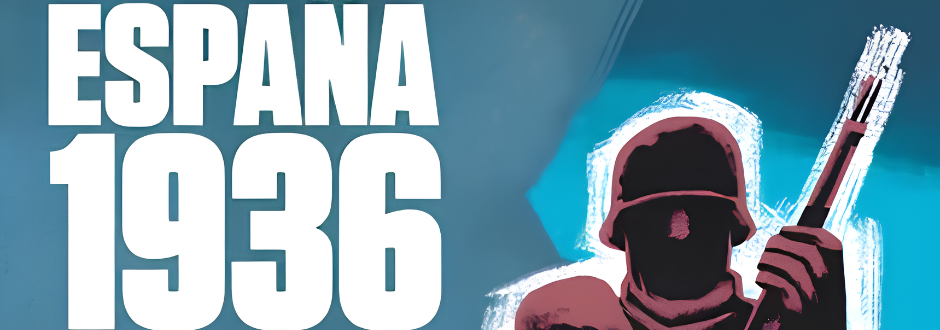
However, the reprint has really refreshed the components, although I do prefer the original artwork on the box, it was more accurate to show two protagonists that seemed to me to be more befitting a depiction of conflict than the lone person on the cover of the new box. That said, the components are for me, a real step up from the earlier edition - the board is a lot sharper, the tokens are bright in the blue and red of Nationalists and Republican factions respectively. The card stock is solid, making even the smallest of the faction tokens easy to handle with nice rounded corners and clearly numbered.
What I didn’t know, as no reader or student of this particular part of modern European historical conflicts was how many different nations and factions were involved - Eastern Bloc, Africa, Italy for example, as well as soldiers and civilian militia from Spain itself. The rulebook l is usefully bookended by a precis of the conflict and timeline for extra helpful information, worth the read.
These different factions are identified via various insignia on the troop tiles - not always easy to spot and one thing that will help you in the game is when setting up, as well as collecting the tokens by colour, and type etc, split them by these various factions - some action cards or events relate specifically to these factions. For example if you are deploying or upgrading troops make sure to keep them faction specific.
These are really nice thematic details - imagine how much easier it would have been to have homogenous tiles, but it would have missed the element of factual depiction the designer was looking for. In what I imagine could have been an emotional decision was a choice to depict a womans face on on the tiles of the Republicans. A magnificent way to reflect that in a civil war not only professional soldiers and men paid the price - I think that little detail is entirely fitting.
How does it play
Set up is a bit fiddly, you can leave the naval battle elements in the box - a previous expansion now included in this version, and take out the relevant cards, but it does take a bit of time to set up but there is a good pictoral reference to help in the rulebook. A small player board doubling as a player aid and a points tracker for your reinforcements feels like a bit of an afterthought but its function over form works well enough.
The game is split into two eras - 1936 to 1937 and 1938 to 1939 - this is again thematically linked to the shifting power balances and external factors and this is reflected in the use of two decks per player spread across the two eras. Each card has a combat, event and some historical flavour text that could be factual or contextual. So we have dual purpose cards that need managing in a small hand of cards only refreshed at the start of each round.
There are several winning conditions, including a quick win for the nationalists if they control Madrid by the end of turn three, and there are only ten rounds so potentially a lot of time even after that to work towards other victory conditions with your strategies.
There are trade offs to be made between throwing the weight of your cards into combat and not having enough left to support your reinforcements - given you can only reinforce at the end of odd numbered rounds, and only based on spending points based on how well your sphere of control is in objective areas, there is a tight tricky balance to be struck.
The combat is dealt with via easily identifiable strength numbers on the tokens and for busy battles you can transfer all the pieces onto the combat board - I would say this is essential as the centre of the board particularly can get very busy. There are no terrain effects or line of sight issues or explosive damage to worry about that can really clutter some combat scenarios in war games, simply add up your no. of dice, add or subtract modifiers and check the results pretty much - Generals are critical for instigating combat and can add their own modifiers - sometimes negatively believe it or not - reflecting their leadership qualities during conflict. In one game playing as the republicans I had an event card that took a nationalist general off the board in the first round…great…only to be countered immediately by the nationalist using a card to immediately replace that general…advantage gained and lost in one turn. So pretty good then at reflecting the swingy nature of conflict and the collective challenges that both sides particularly in a civil war might face.
You can change the course of history but it is not easy - and its not supposed to be, you can’t fight or defend on all front. Focus too heavily on Madrid and cede control of the south to the Nationalists and you can’t reinforce as much as you would like, try to stifle advances from the south and you can easily lose the centre - disaster for the nationalists if they gain control of Madrid by the end of round three - an immediate victory condition. I would recommend downloading the FAQ from BGG as it will help with a few clarifications around combat and movement - the latter being probably the trickiest to get the hang of.
There is a lot to think about here then, dual purpose cards, area majority, combat, movement, supply lines and managing your generals - for fans of lighter gaming experiences this will be a bit too much - I think it will definitely suit war game fans - this feels pretty accurate in terms of setting and definitely theme and whilst the combat has that chance element via dice you know pretty much what you want your combat strength to be going into combat - your opponent can counter with a card but that might come at a cost later.
I must sign off with a nod to the component quality and overall package here, Devir knocking it out of the park on component quality these days, see recent other games of theirs like The White Castle and Covenant, the box doesn’t have to be a shelf breaker to contain all it needs - Espana 1936 maintains that trend. The rulebook is printed on what feels almost like newsprint rather than glossy which feels more grounded in a game like this.
Overall then notwithstanding that the Spanish Civil war is probably niche even in war games - its not WWI or WWII, Stalingrad, Normandy, Company of Heroes etc but even as a slight sceptic coming into this, it has opened a door for me that I wasn’t expecting. War games aren’t for everyone and I think at some point this game might suffer in the long term from its niche focus, you can add the naval expansion for additional variety but essentially it is about the same conflict with the same two sides and although the split deck system will keep card rotation fresh and unique for a while.
The success of this game comes from the fact that the movement, combat and support and area control elements fit together really well once you understand them - However, it is quite a long game 2 to 3 hours with a stiff learning curve, the board gets very busy and its easy to miss some of the icons, could the map board have been a bit bigger - France and Portugal play no part in the game but are represented on the map….with apologies to an entire nation here but could Portugal have been pushed further to an edge and kinda missed off? I’m just saying this because we found board space to be a problem and you end up stacking tiles or trying to offset them and it just gets a bit too fiddly at times.
All this might just add up to too much chaos for some - yes war is chaotic but the physical space of a game still needs to enhance or support the gameplay - I struggled with the game Recall for that same reason, so much going on on the board that I just lost where I was and what I was supposed to be doing - at times we had the same issue here it was just too busy and I found myself spending so much time trying to just work out where I was and what I had, and that took me out of my decision thought process.
That aside, I enjoyed this more than I thought I would and with reference to the comment I made earlier about getting it off the shelf we will, and sooner rather than later because it does need a regular play to embed the rules.
Regular war gamers will no doubt baulk at my perceived short comings of this game but its not an entry level conflict game, so I would say it is for those that want to try a war game but that won’t take 10 plays to learn, or a whole weekend to play but want something more thematic, thoughtful and considered than a single battle scenario experience.